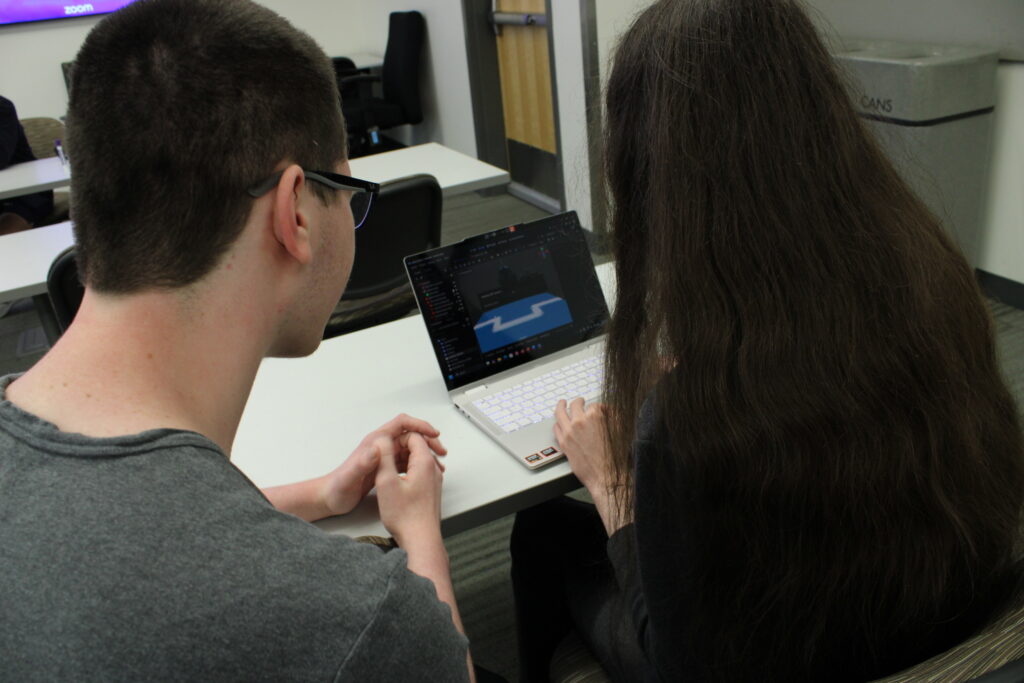
On a Thursday evening, within the Engineering and Computer Sciences Building (VECS), around two dozen students gather to kick off the second annual ScreamJam. Following a drumroll of fist thumping against the desks, organizer Koi Li spins a virtual roulette wheel on the projector. Out of the fifteen possible concepts, the wheel settles on this year’s theme: spiral. The wheel will be rolled again “just for fun”, Li announces, before it once again lands on spiral, prompting a chorus of laughs and humorous remarks claiming the results were manipulated from the start.
Li is the president of the Association for Computing Machinery – Council on Women in Computing (ACM-W) Student Chapter at WSUV, which is co-sponsoring this year’s ScreamJam, alongside the newly established Game Development Club. ScreamJam is a horror-themed, month-long “game jam” competition held in October where teams of up-to-four work together to produce a video game based around a central theme.
In describing a “game jam”, Li says that it is “a creative contest, where developers, programmers, artists, writers, voice actors, pretty much everyone can come together” to create a standalone video game in a short period of time. While they say it is unlikely “a big video game [will] come out of a game jam immediately” they cite popular games such as Hollow Knight and Celeste as originating within a game jam, only later to be developed into full commercial releases.
Aubrey Singhose, a communications major, is the president of the Game Development Club. She notes that while most game jams are in a period of hours to a week, the month-long duration is designed to give busy students a chance to participate fully, while balancing their busy lives.
“We’re in school and we’re doing classes,” Singhose says. “Some of us have jobs”. Extending the time to a month, she says, means “you have all this time to work on it, but you don’t have to spend every second working on it”.
Li, who is a computer science major, recently took up the mantle of president of the ACM-W; an organization which has existed on campus for much of the last two decades. In their own words, they describe the mission of the ACM-W as to “empower and enable and encourage women [and] gender minorities” to become “interested in computer science,” ultimately working toward a shared goal to improve everyone’s computer literacy, computing experience, and professional experience. The club itself is open to students of any gender identity, and despite being a computer science focused club, it is likewise open to all majors.
Both Li and Singhose say their clubs and events like ScreamJam have much to offer students, regardless of their major. The Game Development Club’s faculty advisor, Grant Williams, agrees.
“There’s tons of benefits,” he says for students involved in these organizations and events, on the technical and social side. “From a school perspective, students that are in these kinds of clubs and participating in these events just do better on average.”
Williams describes the process of game development as “an amazing synthesis opportunity” where “you’ve got graphics, you’ve got AI, you’ve got simulation logic” all merging. He sees it as an opportunity for students to “get out of their comfort zone” and “make friendships across the different majors”.
While he coaches the ACM-W’s teams in the International Colligate Programing Competition (ICPC), which will compete in Portland next month, Williams’ role in ScreamJam this year is “just getting to hang out and see the cool games”. In past years, events like ScreamJam were judged by faculty. This year, entries into the competition will instead be judged by their peers.
Williams highly recommends students get involved in organizations and events like ScreamJam or the ICPC.
“I will only use my brief soapbox here to exhort your readers to join a student club if they’re not in one already,” he says. It’s a “great way to meet people and get the most out of your college experience.”
River Song, who is a senior engineering student, leads one of the development teams. Song isn’t new to game development, yet still praised the game jam, saying it “is a great chance to explore different avenues of game making” and allows her to flex her skills in new ways “given that spark of creativity”.
Regarding this year’s theme, Song acknowledges it’s a vague concept that can be interpreted in different ways.
“Of all the ones on the list, [spiral] was the most: ‘what would I do with this?’” Song says. Eventually, she “ended up attributing it to the spiral of emotions and representing that in the game through the character’s downward spiral”, taking a psychological horror approach in her team’s entry to the competition.
Singhose says the broadness of interpretations is the point.
“I feel like a good theme is one that you can apply to more than one aspect of the game,” Singhose says. “When you see other people’s games in the jam, you go, ‘oh! Interesting that they took that theme in that way’.”
“Spiral is specific enough, [yet] vague enough” for a horror game, she explains. “I feel like a lot of people are gonna take that more as a story theme than a gameplay mechanic,” which to Singhose made sense given horror games are often based on atmosphere.
ScreamJam is currently being hosted publicly on itch.io and runs through October 30th.
You may also like
-
Food for Thought: WSUV Students Reflect on Campus Food Options
-
War in Iran: WSUV Students Reflect on the Conflict
-
WSUV Art Exhibition Explores the Connections of Inheritance and Memory
-
From Registration to Representation: Helping Students Make Their Voices Heard
-
Partnership Incoming: WSU Integrating Google AI Tools