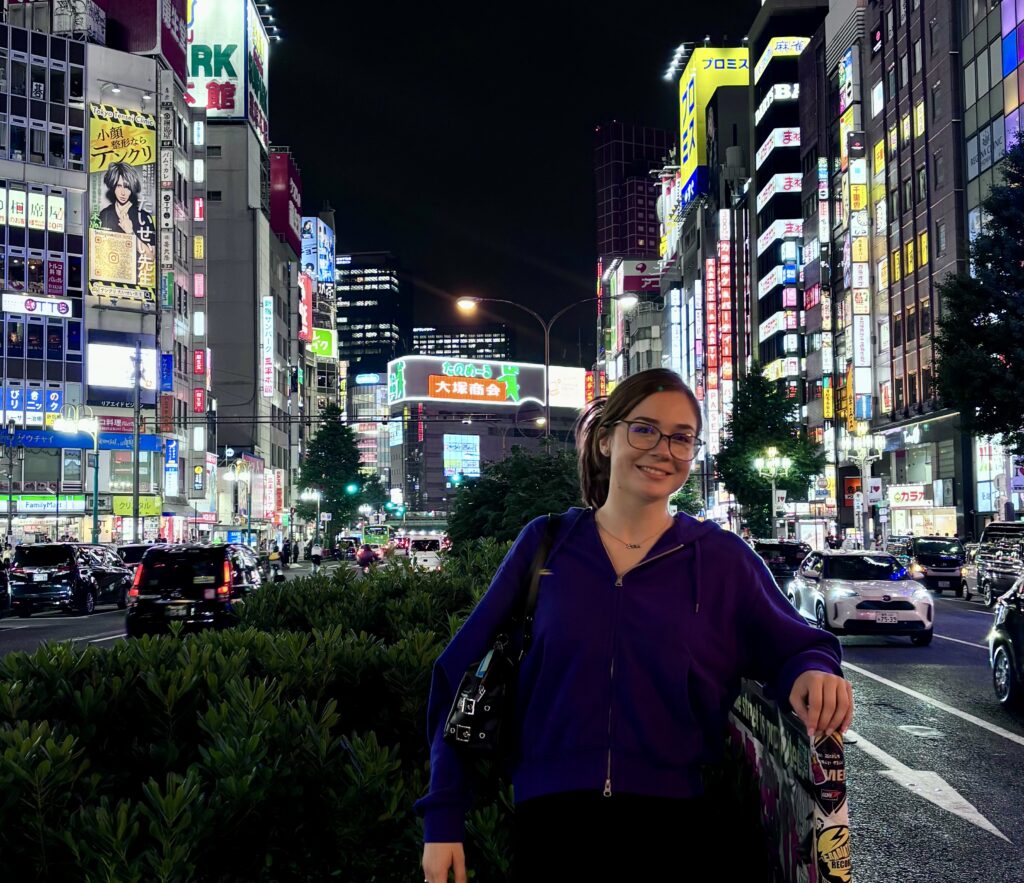
For years, WSUV Student Zoe Thompson imagined what it might be like to live in Japan, and nine-week front-end development internship with Smile Home helped her finally realize those dreams.
The experience was not always easy, but that was part of its value. Thompson returned with stronger technical skills, greater independence, and a clearer understanding of the difference between visiting another country and building a life there.
Thompson found the opportunity through Intern Abroad HQ and interned with Smile Home, a Tokyo-based company that helps people—particularly international residents—navigate housing and daily life in Japan. She worked with the development team on the front-end of the company’s website and its user experience.
Thompson directly contributed to the existing professional codebase. by using React, Next.js, TypeScript, Material UI, and Firebase while working on site improvements that could be reviewed and merged into the company’s main branch.
One project focused on a quiz that recommends places to live in Tokyo based on a user’s preferences, answers, and personality type. Thompson improved the appearance of the results page so that it was more appealing and worked more effectively for users. She also addressed mobile layouts, landing pages, and other user-experience concerns after reviewing the site and presenting possible improvements to the team.
Submitting that work required Thompson to confront a challenge that followed her farther than any international flight: her fear of making mistakes. When her information technology lead asked her to correct part of the first assignment, she nearly panicked. She wanted her work to be reliable and did not want to disappoint the team. “My fear of making mistakes and my perfectionism were holding me back,” Thompson reflected.
Over time, feedback became part of the work rather than an indication that she did not belong. Thompson learned to collaborate, manage her time, organize online projects, share files, and remain with a problem until she found a solution. She also became more comfortable using GitHub and gained experience with Next.js, Firebase, and Amazon Web Services—tools relevant to the technology career she hopes to pursue.
Thompson credits WSUV’s Digital Technology and Culture (DTC) program with giving her the foundation to contribute her work.
In web-development courses taught by Professor William “Will” Luers, she learned JavaScript, how webpages function, and how to build a website properly. A UI/UX course with Professor Chris Dreger taught her to create and prototype designs in Figma. She said John Barber’s Language, Text, and Technology course also helped her consider how technology shapes people and what clients and consumers want.
Apart from the challenges she faced in her work, she also had to face the hurdles of her environment.
Tokyo’s scale was one of the first things she noticed. Trains felt like “sardine cans,” and the number of people combined with limited space could be overwhelming. Even grocery trips became stressful when her 10 months’ worth of studying beginner Japanese could not overcome the language barrier.
The internship itself did not require fluency in Japanese, but language differences shaped her daily life. Asking for help was difficult because being able to form a question using a few basic words did not mean she could always understand the answer.
Her social anxiety sometimes made entering a five-seat izakaya feel like “an introvert’s worst nightmare.” Still, she found that many restaurants accommodated solo diners, and she gradually learned how to navigate unfamiliar situations.
A visit with a friend helped ease the isolation. Thompson had met the friend through HelloTalk, a language-exchange application that allows the user to communicate with native speakers to aid in learning a language. Speaking Japanese with him while he practiced English reminded her that she had connections in the country. “I do know people here, so I’m not alone,” she recalled thinking. “It is strange to feel alone when millions of people surround you.”
Thompson also stayed connected with her family through calls and weekly video games with her brother. When a magnitude 5.8 earthquake struck, she ran outside and called him in tears, in which he helped calm her down. This frightening moment was one of many reminders that independence did not mean never needing support.
Financing the trip also required planning. Thompson received approximately $3,000 through the Benjamin A. Gilman International Scholarship, a U.S. Department of State program for undergraduate students with financial need who receive Pell Grants. The scholarship helped cover her plane ticket, food, and share-house fees—about 75 percent of her program costs.
Thompson still had to plan and pay initial costs, but she noted that the award “made a world of a difference” in reducing the financial pressure and allowed her to focus more fully on the internship and the experience of living abroad.
She hopes other students will not eliminate themselves from opportunities because of the price. “Do not let your dreams turn to dust,” Thompson urged. “Most importantly, do not reject yourself before you even apply—just apply.”
Outside work, Thompson documented meaningful moments in photographs and is turning six of them into paintings. One will depict Hiroshima’s Atomic Bomb Dome, which she described as harrowing after visiting the Hiroshima Peace Memorial Museum. Another will show Miyajima’s large Torii gate in the water at the Itsukushima shrine, which she walked up to and touched after hearing that doing so could bring a year of good luck.
The trip also changed how Thompson thinks about returning to Japan. She remains interested in working internationally and would consider living in Japan again, but likely not in Tokyo. Experiencing the city’s density and pace taught her that she is not a city person—a discovery she is grateful she made during a temporary internship rather than after committing to a full-time job.
Most importantly, Thompson learned that living abroad is not a continuous vacation. It includes work, laundry, groceries, exhaustion, homesickness, and bad days. At first, she felt guilty when she was lonely or overwhelmed because she had worked so hard to reach Japan and believed she should enjoy every moment.
Eventually, she understood that difficulty did not make her ungrateful nor make the experience a failure. It meant she was living in a place rather than consuming it as a tourist. “Growth does not always feel dramatic while it is happening,” Thompson said. “Sometimes it looks like getting on the train the next morning, going to work, solving another problem and realizing a few weeks later that something that originally felt intimidating has become normal.”
You may also like
-
The WSU Foundation is Holding a Student Art Contest, and Winners Get 500 Dollars Each
-
Annual Professional Clothing Closet Helps Students Dress for Success
-
Your Voice, Your Vote: How WSUV Students Are Approaching the Midterm Elections
-
Exhibit Artists McKinney and Lam Reflect on Family and Their Art
-
Early FAFSA Launch: What Changes and How This Affects Your Financial Aid