Thousands of students walk beneath the trees at WSUV every year, perhaps appreciating their shade on a hot afternoon or their changing colors in the fall without realizing how much is happening within and beneath the canopy.
The trees across WSUV provide more than scenery. They create habitat for wildlife, shade Mill Creek, help maintain cooler water temperatures for aquatic species, and offer students quiet places to walk, study, and escape the demands of campus life.
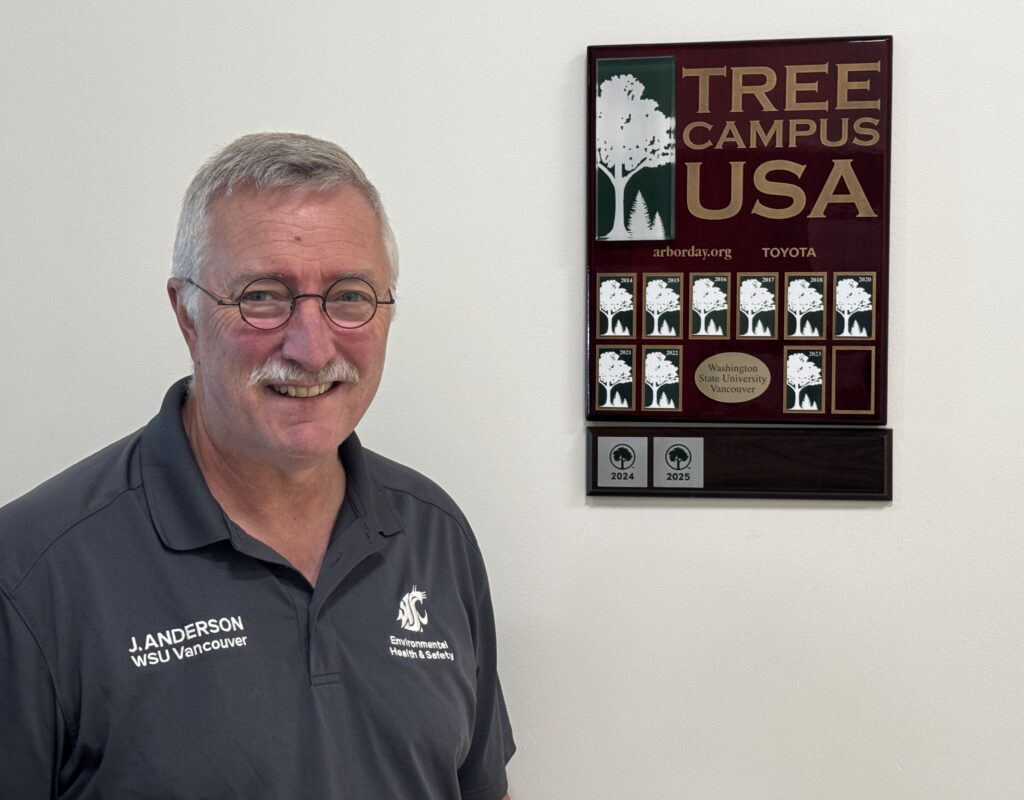
That relationship between the university and its trees is formally recognized through WSUV’s status as a Tree Campus through the Arbor Day Foundation, a recognition the university first received in 2014.
“Tree Campus is part of the Arbor Day Foundation, and it is a nationwide program that recognizes institutions — in our case, higher education — that are making efforts to promote trees and tree growth and all of the values and services that come with trees,” said Jon Anderson, an Occupational Safety and Health Professional who works with WSUV’s Tree Campus program.
Anderson explained that the university’s existing tree inventory documents more than 6,000 trees, but large portions of campus were not included. Based on the available information, he estimates the actual number may be around 10,000.
The inventory uses Geographic Information Systems (GIS) along with GPS coordinates to document individual trees. Information such as a tree’s location, size, and species can be recorded to create a database of the campus forest.
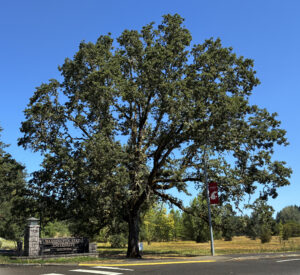
Among the thousands of documented trees, one stands apart for Anderson: a massive Garry oak, also known as an Oregon white oak, near the entrance of campus. Estimating that it is about 300 to 500 years old, Anderson described the Garry oak as “borderline iconic” to WSUV and named it his favorite tree on campus.
However, the Garry oak is not the only senior resident of the university. Anderson noted that WSUV also has large fir trees that are approximately 100 to 150 years old.
WSUV’s Tree Campus recognition involves more than simply having a lot of trees. According to Anderson, the university must meet several requirements to maintain its designation, such as holding an Arbor Day observance, completing a service project with an educational component, and maintaining a Tree Committee.
The committee includes faculty, staff, students, and community members who meet to discuss issues involving campus trees. It is advisory, meaning it does not have final authority over whether a tree can be removed. However, Anderson said it creates an opportunity for people to discuss what is happening to campus trees before decisions are made.
“There is a certain amount of tree management that is important,” Anderson stated. “Sometimes that means we have to thin trees out and give room for the other trees to grow.” Anderson recalled seeing a red oak he estimated to be 30 to 40 years old being removed near a campus construction project. While there may not have been an alternative to removing the tree, he said he would have liked the Tree Committee to have been given the opportunity to discuss it beforehand.
The value of WSUV’s trees becomes particularly visible in the riparian zone, a vegetated area surrounding a creek or stream, surrounding Mill Creek. At WSUV, trees along Mill Creek provide shade that helps keep the water cooler, which is important for the wellbeing of the organisms living in the creek.
The trees also create habitat above and around the water. “You have habitats for birds and animals, insects, and all sorts of things,” said Anderson. This summer, Anderson observed bald eagles have been flying around WSUV’s tree canopy. “You hear them screeching out there and carrying on,” Anderson said. Small mammals use vegetation along the riparian zone for shelter, while birds of prey use the same ecosystem for hunting. “It’s a very connected system, how the trees interact,” Anderson remarked.
Native trees have an especially important role because they support native ecosystems. Anderson explained that plants, animals, insects, and microorganisms evolve alongside one another and can develop highly specialized relationships. Some organisms may spend their entire lives associated with one type of tree — or even within a particular section of a tree.
In addition to what’s hidden, some of the benefits of the trees are much easier to see. They provide shade on hot days, protection from rain, and places for students to relax between classes. Anderson particularly recommends exploring WSUV’s trails through the riparian zone.
Students also have opportunities to participate in WSUV’s Tree Campus efforts by becoming a part of the canopy’s future. Anderson said students are encouraged to participate in the Tree Committee and can contact him if they are interested (jon_anderson@wsu.edu).
“We want and need to have student participation in the Tree Committee,” Anderson expressed. Future Tree Campus events may also provide opportunities for students to volunteer and participate in environmental stewardship.
Anderson himself has participated in planting trees at WSUV. As a graduate student, he worked with StreamTeam on campus tree-planting projects and served as a team leader. Today, however, he emphasized that much of the hands-on responsibility for caring for the trees belongs to WSUV’s grounds crew.
For Anderson, one of the important lessons behind being a Tree Campus is surprisingly simple: people should notice what trees are doing around them. “They do purify air, they do provide oxygen, they provide shade, and they provide habitat,” Anderson mused. “And they’re beautiful and peaceful, and they’re a nice place to just hang out underneath.”
Even campus traditions are connected to the trees. For example, greenery collected from trees on campus has been used to make holiday wreaths. “They smell nice and they’re pretty and they’re festive,” Anderson said. “Just one more example of how trees are integrated into our society and our community.”
But perhaps the easiest way to understand their value requires no scientific equipment. Anderson encourages students to walk through the riparian zone, sit beside Mill Creek or stop at the entrance to look at the sprawling Garry oak that has likely been growing there for centuries.
In the rush between classes, work, and everything else demanding attention, the forest surrounding WSUV can easily become part of the background. However, the canopy above WSUV is not simply decoration. It is a habitat, history, and a living part of the campus community.
You may also like
-
SW Wash. Locations Accepting Unused Medications for National Drug Take Back Day
-
VSCI Unveils Consolidated Advising Space for WSUV Students
-
Student-Led Organizations: Building Community on Campus
-
Threat or Tool? Professors Weigh-in on AI in the Classroom
-
The WSU Foundation is Holding a Student Art Contest, and Winners Get 500 Dollars Each