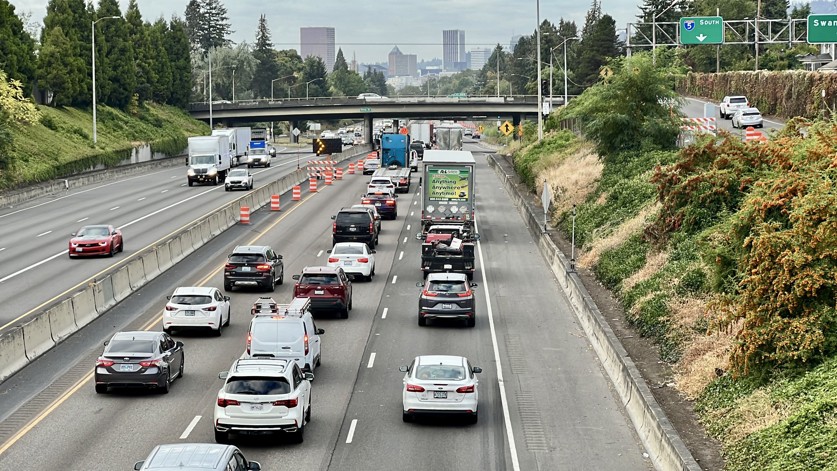
For members of the WSUV community who regularly travel between Vancouver and Portland, the southbound Interstate 5 (I-5) closure has created longer commutes, heavier traffic, and changes to everyday routines.
The Oregon Department of Transportation (ODOT) closed southbound I-5 between the north and south ends of Interstate 405 (I-405). The closed section travels through an area where I-5, I-405, and I-84 connect within a relatively short distance. ODOT expects the closure to last approximately five weeks.
David House, a public information officer for ODOT, said the closed section of I-5 needs extensive preservation work. The bridge and travel surfaces in that area have not been replaced since 1985, even though resurfacing would typically be completed about every 20 years.
The highway is not only important to Portland-area residents. It is also a major West Coast route used by travelers and commercial vehicles moving between Canada and Mexico. The Portland section is especially challenging because, according to House, it is the only part of I-5 in an urban area that narrows to two lanes.
Crews are grinding away, repairing, and replacing several inches of asphalt and concrete, reinforcing steel, and restriping the freeway. The project also includes improvements to stormwater drainage, an issue ODOT has wanted to address for many years.
According to House, closing the entire southbound freeway allows the work to be completed more safely and quickly. Closing one lane at a time would have taken approximately two years and cost an estimated $9 million more.
“Getting it over quickly is the safest, fastest, and cheapest way to get it done,” House said.
ODOT selected this time of year because it avoided major events and festivals while remaining within an acceptable weather period for pouring concrete and laying asphalt. Crews are working in shifts 24 hours a day, seven days a week. Replacement equipment, parts, and mechanics are also available around the clock to minimize delays if machinery breaks down.
House described the five-week closure as “a marathon, not a sprint.” He explained that changing travel habits for a few days may be manageable, but maintaining those changes for five weeks is more difficult. He encouraged travelers to continue working remotely, adjusting their schedules, using public transportation, and avoiding the area whenever possible.
However, those changes directly affect students such as Perla Rolon-Gonzalez, who lives in Portland and travels to WSUV every day.
Rolon-Gonzalez said the closure has added approximately 30 minutes to some trips. When traffic becomes especially heavy, she sometimes leaves the highway and uses surface streets before returning to Interstate 205 (I-205). That alternative also takes more time because of traffic signals and the increased number of drivers trying to avoid the freeway.
“Even if we get on I-205, there’s always traffic in the afternoon,” Rolon-Gonzalez said. “It always gets really stacked, especially if you’re heading to Clackamas.”
Her commute to campus is not the only part of her routine affected by the closure. Rolon-Gonzalez said she frequently visits downtown Portland, Hillsboro, and Beaverton. She recently decided not to visit a farm in Wilsonville because traveling there would have required using the congested freeway system.
“If I want to go out or do any activities, I have to stay in the Vancouver area,” she said.
Although Rolon-Gonzalez has not been late to class, avoiding delays requires additional planning. She gets up earlier and checks navigation apps before leaving home so she can estimate traffic conditions. The closure has not prevented her from reaching campus, but it has added uncertainty to a commute she must make regularly.
“Wake up early and check your maps to see how long the traffic is, or find an alternative route,” Rolon-Gonzalez advised other students and employees. She also encouraged travelers to remain safe and acknowledged that people who depend on the freeway to reach school or work may have few practical alternatives.
Cassidy Johnson, another WSUV student, does not normally travel on I-5, but she has still felt the effects of the closure on I-205.
Johnson usually takes I-205 to school. Her trip to campus has not changed significantly, but the drive home has become longer. A commute that normally takes approximately 40 minutes can now take an hour.
“I didn’t think it was going to affect me as much as it did because I was like, ‘Oh, I don’t take I-5. I’ll be fine,’” said Johnson, explaining that she didn’t account for the people who have had to change their normal route to avoid the closure. Drivers who normally use I-5 are being directed toward I-205, adding vehicles to a route already used by commuters traveling between Vancouver and communities east and south of Portland.
The increased congestion has caused Johnson to arrive late to class once. She has not been late to work because of the closure, but she worries that, “sitting there and waiting longer definitely uses more fuel.”
Her advice to other travelers is to check navigation apps before leaving but not rely entirely on the estimated arrival time. “Try to leave a little bit earlier than that, too, because you never know if you start driving and then traffic gets worse,” Johnson said.
The closure is also affecting employees who commute to WSUV.
Lisa Fuget works for Canteen, the company that provides food, drinks, and snacks for the campus cafeteria’s mini kitchen. She travels between Portland and Vancouver twice each day.
Fuget begins working at 6 a.m., which has allowed her to miss the brunt of morning traffic. Her return trip, however, can become difficult if she leaves Vancouver too late. According to Fuget, southbound traffic begins increasing at approximately 2 p.m. Her normal 20-minute drive home once took 45 minutes because traffic was backed up toward the Portland International Airport exit.
“I can’t change my route. It’s the only way I can go,” Fuget said. Her only other option would require traveling toward Tigard and circling back, creating an even longer trip.
She recommended that students and employees use C-TRAN or another public transportation option when possible. However, she recognized that not everyone can change how or when they travel.
Despite the inconveniences, Fuget said ODOT and the Washington State Department of Transportation (WSDOT) provided sufficient warning before the closure.
“They started a couple months ago telling us that this was going to happen,” Fuget said. “They had it on the news, they had it on the radio, and they had signs. We knew it was going to happen a couple months out.”
Sarah Hannon-Nein, a public information officer for WSDOT, said the closure is an ODOT project because the construction is taking place in Oregon. ODOT and WSDOT are separate state agencies responsible for building and maintaining their respective highway systems. However, WSDOT is coordinating with ODOT and monitoring possible effects on Southwest Washington travelers.
WSDOT operates its traffic management center around the clock and works with law enforcement to monitor congestion and respond to incidents. The agency can also adjust traffic signals and ramp meters in real time when necessary.
Hannon-Nein said WSDOT displayed information about the closure on 10 electronic message boards. Portable boards placed by ODOT and the City of Vancouver brought the regional total to approximately 20 signs informing travelers about the closure.
Both agencies also have public information officers available around the clock to respond to emergencies and provide updates. Hannon-Nein is WSDOT’s designated public information officer for the closure and would help prepare messages if an incident caused significant effects in Southwest Washington.
At the time of the interview, Hannon-Nein said the closure had not caused major backups on the Washington side of the river beyond the congestion normally expected during busy travel times. However, she cautioned that a collision, disabled vehicle, or other incident could quickly change conditions.
“Our ask has just been that travelers plan ahead and expect delays,” Hannon-Nein said. “I think a big reason why the project is going so well, and we aren’t seeing as many backups as we anticipated is because drivers changed their behavior and changed their routine.”
ODOT and WSDOT are asking travelers to continue planning ahead, checking current traffic conditions and avoiding peak travel periods. They also recommend C-TRAN and TriMet for people who can use public transportation.
House said ODOT worked with WSDOT, the Portland Bureau of Transportation, cities, counties, TriMet, emergency-response agencies and other organizations for months before the closure began. ODOT has also pre-positioned tow trucks and incident-response vehicles so disabled vehicles and crashes can be cleared more quickly.
Once completed, the work is expected to provide a smoother travel surface, improved drainage, and the beginning of new auxiliary lanes. Those lanes will give drivers more room and time to merge between I-5, I-405 and I-84. ODOT expects the changes to improve safety by reducing the need for hurried or last-minute lane changes.
Until then, students and employees traveling between Portland and Vancouver will need to continue planning for delays. For some, the closure has meant only leaving home a little earlier. For others, it has doubled commute times or limited where they can go outside school and work.
“Keep doing what you’re doing,” House said. “Don’t get complacent because the traffic hasn’t been that bad. The reason it hasn’t been that bad is because, if you weren’t in the traffic but normally would be, you’re doing the right thing.”
You may also like
-
The WSU Foundation is Holding a Student Art Contest, and Winners Get 500 Dollars Each
-
Annual Professional Clothing Closet Helps Students Dress for Success
-
Your Voice, Your Vote: How WSUV Students Are Approaching the Midterm Elections
-
Exhibit Artists McKinney and Lam Reflect on Family and Their Art
-
Early FAFSA Launch: What Changes and How This Affects Your Financial Aid