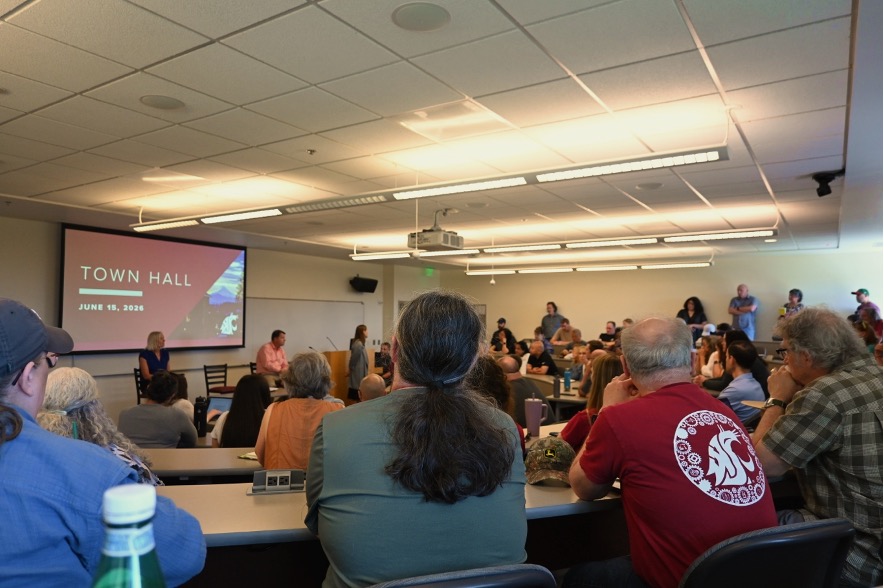
WSUV is preparing for a 15% budget reduction and is currently awaiting decisions. The reduction, discussed at a recent campus town hall meeting, has raised concerns among faculty and staff about potential layoffs, increased workloads, and the long-term impact on campus operations.
Executive Vice President Sandra Haynes and Senior Associate Vice President for Finance and Operations Damien Sinnott addressed questions from employees while outlining the factors they say contributed to the reduction.
Campus leaders cited enrollment declines, state budget pressures, and federal funding uncertainty as employees raise concerns about staffing, workload, and future operations. The latest town hall addressed various questions and ongoing uncertainty, but it did not fully reassure faculty and staff, who expressed their opinions and remain unsettled about the future.
Earlier this year, WSU Vancouver publicly prepared for possible budget reductions of 3%, 5%, and 10%. Described in the Budget Forum earlier this year, the information informed faculty, staff, and students of a 9.8% baseline reduction for FY26, amounting to $4.3 million. “In May, we were then told what our budget cut would be, and it was, as you all know, larger than we expected, at 15%,” Haynes said.
The announcement by Leslie Brunelli during the special meeting on May 18th shocked many in the WSUV community. This marks a significant shift in the campus’s budget-planning process and required administrators to revise proposals already developed under the earlier scenarios.
“We submitted that plan last week … hoping that they would give us consideration for the early submission and give us some information earlier … than what is on the schedule, which is June 24th,” Haynes said.
The revised proposal is expected to be reviewed later this month, with campus leaders hoping to receive additional guidance on implementation and future planning. At the moment, there is no official or finalized proposal report for faculty and staff.
Enrollment Decline and Finding Pressures
- Enrollment
EVP Sandra Haynes said, “Our enrollment is down about 22% from its high in 2019, almost a quarter of our students from our high, we were staffed and ready to go at that level, and then our enrollment started to dip.” While further elaborating that it will take time to come back, this is a provided reason for the need for cuts.
- External Factors
EVP Sandra Haynes said, “WSU was cut by the state, and we’re expected to be cut by the state again next year. The state is in a financial problem; we’re state agencies, so we are seeing the effects of that.” Haynes also addressed the decline in federal funding that is attributed to grants and research
Largest cut of the pie
As many know, WSUV received the largest percentage cut, 15%, among statewide campuses, while Everett faced a 10% reduction and Pullman a 9% reduction. Other campuses, such as Spokane and Tri-Cities, do not have direct cuts but are addressing adjustments differently; some of the cuts are hidden, but they still have instructions. Spokane is right-sizing its current budget under the provost’s leadership, and Tri-Cities is considering a reduction to its Institute for Northwest Energy Futures (INEF); reduced to ½ by the state.
A question that drew mutual agreement was: if Pullman is a larger campus, why didn’t it receive a higher percentage reduction than WSUV? On the Pullman campus, the colleges are a unit that has separate budgets, just like budget offices and facilities.
“There wasn’t a Pullman campus cut; there was a cut in the unit, we are a unit [WSUV campus], which makes us sound like we got this big cut. Overall, it was because we are considered a unit” Haynes said.
Furthermore, the cost of central services that support all statewide campuses continues to increase each year. Sinnott explained that campus contributions are based on a percentage of tuition revenue, meaning enrollment levels and tuition revenue play a significant role in a campus’s financial position.
As a result, these factors were considered during evaluations of each campus’s ability to withstand financial pressures. Senior Associate Vice President Damien Sinnott described how Vancouver’s assessment was conducted: “When you look at Vancouver right now as an example, they took a look at funding, state funding, core funding, per AFFT (Annual Average Full-Time Equivalent); per student, as a measure of our enrollment.”
Sinnott also noted that Vancouver receives approximately $2,500 more per student in state funding than Tri-Cities.
Employees Express Concern About Jobs and Workload
Much of the town hall focused not on spreadsheets or budget formulas but on the people who may be affected by the reductions.
Employees submitted questions regarding layoffs, healthcare, retirement planning and the possibility of increased workloads if staffing levels decline. Haynes acknowledged the uncertainty many employees are experiencing.
“It’s hard not knowing what our futures will be. It’s hard not knowing how we’re going to take those cuts,” Haynes said. “I’m sure that some of you are very angry, some of you are very anxious.”
Several employees asked how remaining staff would be expected to manage additional responsibilities if positions are eliminated. Haynes said university leaders are not approaching the reductions with the expectation that employees will simply take on more work.
“We’re not going to say, well, do more with less,” Haynes said. Instead, she indicated that some services and processes may need to change as the campus adjusts to reduced resources. “We may have to let some things go,” she said.
A university administrator later echoed that reality, stating that “service levels will change. They will have to.” While no specific staffing decisions were announced during the meeting, administrators acknowledged that the coming months could bring difficult choices for departments across campus.
Questions About Spending Priorities
Employees also questioned whether administrative spending, executive compensation and other university expenditures were receiving the same level of scrutiny as staffing and operational budgets. Others asked whether athletics spending played a role in the university’s financial situation. Sinnott said the budget reductions being discussed are separate from athletics funding.
“Athletics is entirely separate,” Sinnott said. “What we’re talking about here … is more operating budget forward year over year.” The exchange reflected a broader desire among employees for greater transparency regarding university finances and how budget priorities are established.
What Students Should Know
Although much of the discussion focused on employees, students could also experience indirect effects depending on how reductions are implemented. University leaders said protecting the student experience remains a priority, and no major academic program eliminations were announced during the town hall.
However, changes in staffing levels and service delivery could affect advising, administrative support and other campus operations.
At this stage, many decisions remain under review, and university officials say the full impact of the reductions has not yet been determined.
What Happens Next
WSU Vancouver has already submitted its revised budget proposal following the announcement of the 15% reduction target. Campus leaders expect the proposal to be reviewed on June 24 if not sooner, a date many employees are watching closely as they await additional information about implementation and future planning. For now, significant questions remain about how the reductions will be distributed and what long-term effects they may have on the campus.
What became clear during the town hall is that WSU Vancouver has moved beyond preparing for potential reductions and is now confronting a budget challenge larger than any scenario publicly discussed earlier this year. For students, employees, and members of the Vancouver community, the coming weeks may provide the clearest indication yet of how those decisions will shape the future of the campus.
You may also like
-
SW Wash. Locations Accepting Unused Medications for National Drug Take Back Day
-
VSCI Unveils Consolidated Advising Space for WSUV Students
-
Student-Led Organizations: Building Community on Campus
-
Threat or Tool? Professors Weigh-in on AI in the Classroom
-
The WSU Foundation is Holding a Student Art Contest, and Winners Get 500 Dollars Each