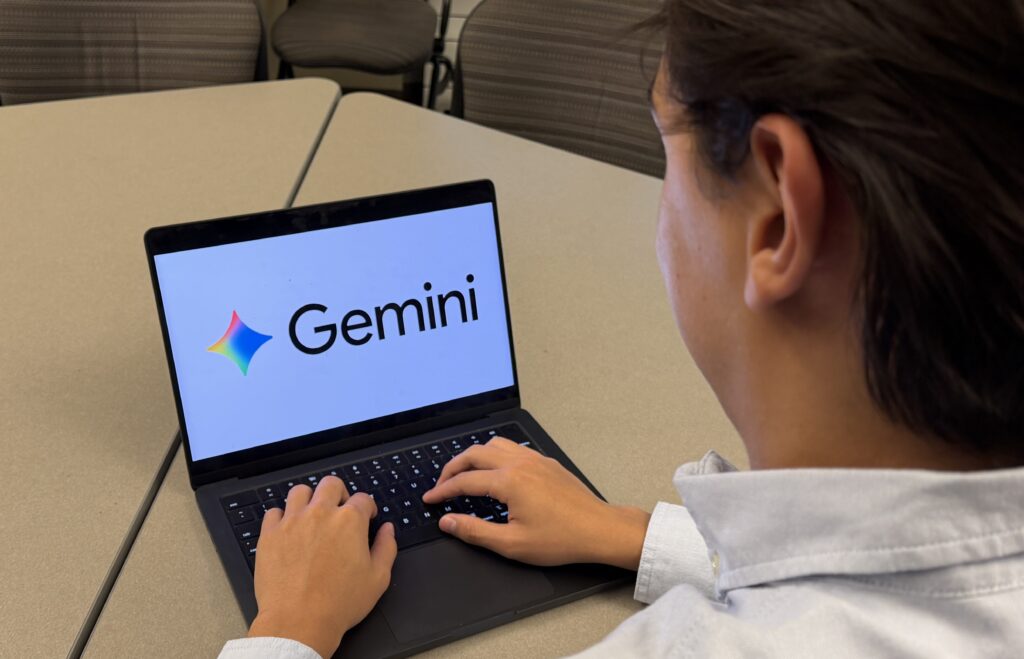
In the coming weeks, WSU will officially announce its partnership with Google, which will provide students, staff, and faculty access to Google’s AI services.
Beginning Oct. 12, WSU faculty and staff will have access to Google Gemini and Gemini Notebook through their WSU accounts. Students will receive access one week later, on Oct. 19, according to Tony Opheim, WSU vice president and chief information officer of Information Technology Services (ITS), and Jacqueline Southwick, WSU director of ITS system communications and customer experience.
These AI tools will be available systemwide across all WSU campuses.
The rollout is part of what Opheim described as a “highly distributed exploratory phase” for AI at WSU, as the university evaluates rapidly changing AI technology and how it can be used across the university.
“The rate of change of AI is faster than, I mean, I’ve been doing this gig for 35 years, and I’ve been through the creation of the internet itself, creation of email,” Opheim said. “All of that pales in comparison to what this is…it’s [AI] is changing daily.”
WSU already provides students with access to Microsoft Copilot Chat through their WSU accounts. Opheim said the university has found that many students are not aware that the tool is available.
He described Copilot as an introductory option for students that includes safeguards and is available without students having to purchase their own subscription.
“It’s a baby step. Think of it as AI, maybe with some training wheels…it’s a great place to get started and you know, learn.” Opheim said.
The university is now adding Google’s Gemini and Gemini Notebook as another option for the WSU community.
Different uses across WSU
According to Southwick, WSU is “not seeing AI as a single product solution for students, faculty, or staff. We’re looking at the different tools that may be appropriate for the different purposes.”
Opheim and Southwick are hoping for Google’s Gemini to be used in a variety of ways that will make people’s day-to-day routines and tasks more efficient.
“We’re using AI to solve real problems on the technology side, academic side, and in the student experience environment,” said Southwick.
Southwick said WSU employees are already bringing forward ideas for using AI to streamline their work. One example she gave was using AI to help develop student schedules by finding combinations of courses that fit students’ degree plans.
According to Opheim, another priority is giving students, faculty, and staff opportunities to gain hands-on experience with AI.
He hopes WSU could eventually provide more immersive training where students work directly with different AI tools and develop skills through repeated use.
Opheim said AI skills will require more than simply knowing how to write prompts. Users need to learn how to work with AI, identify errors, and correct its responses.
He said students and employees need opportunities to build what he called “muscle memory” when working with AI, including learning how to recognize when an AI-generated response is incorrect.
Opheim wants WSU faculty to feel empowered to apply AI tools in a way that suits their classroom needs. “The classroom belongs to the faculty member…they got to be able to do it their own way, to be able to leverage; they are the subject matter experts.”
In regard to how AI should be used at WSU, Southwick emphasized that integrating AI into the university system is “for the benefit of the students.” Using AI for administrative and employee tasks will free up more time for advisors and faculty to work with students hands-on. For students, they can use AI for organizational purposes so they can dedicate their time to completing coursework.
“If it doesn’t benefit the students, there’s no point.”
Developing guidelines for responsible use
Along with expanding access, WSU officials are working to establish expectations for how AI should be used.
An ethical principle regarding the use of AI that Opheim emphasizes is that people remain responsible for the work produced with AI.
“You can’t blame AI, because you own it,” Opheim said.
He said users should verify AI-generated information based on the potential consequences of an error. A minor mistake in a low-stakes task would require less review and carry less risk compared to an error in something that could affect a person’s grade, pay, or reputation.
Southwick said students must also understand that AI is becoming part of the professional environment and should learn to use the technology responsibly.
“Students need to learn how to use AI ethically; they need to take ownership of AI that they’re using. They need to embrace it as part of our future as a society. It’s not going away, it’s not an evil, it’s something that needs to be managed, and it’s really important that we learn how to do that.”
Opheim said WSU’s approach is intended to give people who want to use AI ways to do so while also addressing concerns from people who are uncomfortable with the technology.
“WSU is very polarized. We’ve got both faculty and students that think this [AI] is the greatest thing since the calculator or the internet…and then we’ve got others that think it’s the worst thing.”
According to Opheim, the goal of implementing AI into the WSU system is to bring people to middle ground.
Security and student information
Data security is another consideration as WSU expands access to AI.
“We have ways of building safe perimeters,” said Opheim. Despite this, he still urges people to be cautious about putting sensitive information into any AI service.
He added that one of their responsibilities when working with companies like Microsoft and Google is contracting with them so they will not train AI with student or employee data.
Southwick said creating a secure environment is a priority as the university expands AI access.
“We’re focused on enabling in a safe environment,” she said. “We aren’t willing to compromise on that.”
Cost and future of AI at WSU
While the university is expanding access to tools that can be provided at little or no direct cost, Opheim said larger AI initiatives will require additional funding.
Currently, there is no payment required from WSU in its partnership with Google or use of its AI tools.
He said integrating AI into university curriculum can require six to nine months of planning and development. His AI Catalyst program is currently funded through the end of the 2026-2027 fiscal year, but he said he does not yet know what funding will be available after July 1.
He also emphasized that there is not one AI tool that will remain the best option for every task.
“There is no one AI to rule them all,” Opheim said.
As technology continues to change and develop, WSU officials said they expect the university’s approach to continue changing as well.
He said that WSU’s learning experience with how to use AI must be shaped by students’ perceptions of AI.
Opheim encouraged students to participate in conversations about how AI should be used at WSU and said university technology leaders such as himself and Southwick want to hear student perspectives.
You may also like
-
SW Wash. Locations Accepting Unused Medications for National Drug Take Back Day
-
VSCI Unveils Consolidated Advising Space for WSUV Students
-
Student-Led Organizations: Building Community on Campus
-
Threat or Tool? Professors Weigh-in on AI in the Classroom
-
The WSU Foundation is Holding a Student Art Contest, and Winners Get 500 Dollars Each