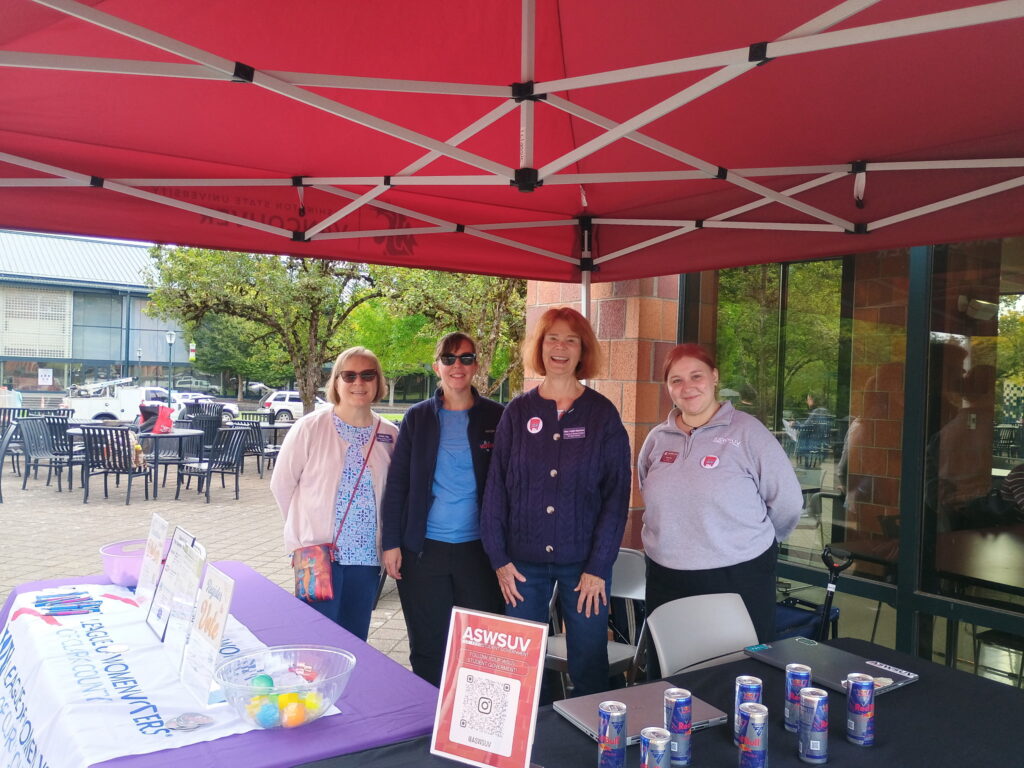
For students balancing classes, jobs and family responsibilities, voting can become another task competing for limited time. Researching candidates, understanding ballot measures and sorting through conflicting information may feel overwhelming. ASWSUV and the League of Women Voters of Clark County are working to make participation more approachable by connecting students with information, assistance and opportunities to become involved.
Mary Austin-Seymour, the League’s liaison to WSUV and Clark College, as well as Keeley Reid, ASWSUV’s Director of Legislative Affairs, approach that work from different positions. Their shared goal is to help students understand the voting process and recognize the influence they can have.
“Our motto is empowering voters, defending democracy,” Austin-Seymour said.
The League combines voter registration and education with advocacy on public policy issues. Its nonpartisan commitment means it does not support or oppose candidates or political parties, although it takes positions on issues. That distinction allows the organization to help voters evaluate their choices without recommending a particular candidate.
“We never endorse candidates,” Austin-Seymour said. “We won’t even say if a candidate more aligns with our positions or not.”
She sees that approach as a strength. The League can provide a setting where voters ask questions, explore information and make their own decisions. Candidate forums are one resource she recommends, particularly for voters unfamiliar with the names on their ballots. Recorded forums also allow people to learn about candidates without attending an event in person.
“There’s really nothing like actually hearing the candidates talk and answer questions,” she said.
Austin-Seymour’s campus outreach continues between elections. She participates in student involvement fairs and other events, helping students register and answering practical questions. Some students have never received a ballot. Others have moved or are unsure how to begin researching their choices. Each conversation offers an opportunity to make an unfamiliar process more understandable.
Reid brings a student perspective to that work, representing student interests at the local, state and federal levels. As a history major planning to pursue pre-law, she views student government as both preparation for her future and an opportunity to serve her community.
“I love to give back. I love to represent our community,” Reid said.
Her responsibilities include gathering student concerns through conversations, surveys and town halls, along with researching legislation affecting tuition, mental health, accessibility and campus resources.
Reid said Austin-Seymour helped with the campus’s National Voter Registration Day tabling event on September 15. League volunteers also attended Goats for Votes, where students could interact with goats while learning about registration and elections.
The event’s appeal was intentional. Reid wanted an inviting activity that would encourage students to stop and engage. The goats provided an opening for conversations that students might otherwise pass by, bringing voter outreach into a familiar campus setting rather than requiring students to seek it out independently.
However, attracting attention is only part of encouraging participation. Reid emphasized the importance of researching claims carefully, while Austin-Seymour said students frequently ask where they can find trustworthy information amid conflicting social media content.
“I think that there is a lot of fake news out there, and you have to do the right research,” Reid said.
Austin-Seymour recommends voters’ guides, candidate forums and the voting records of candidates who have previously held office. Those resources allow voters to compare campaign statements with documented actions. She also encourages critical reading, noting that statements submitted by candidates should not automatically be treated as independently verified information.
For some students, the challenge is finding enough time to feel informed. Austin-Seymour recalled a student at Goats for Votes who did not want to participate without first researching the election thoroughly. Academic demands made that feel difficult, illustrating how the desire to vote responsibly can become a reason to postpone voting altogether.
Her advice is to begin with the races and issues the voter understands. Feeling uncertain about one contest does not mean someone must leave the entire ballot unused.
Practical preparation matters as well. She encourages students to check their voter registration address, especially after moving. An outdated address can leave someone waiting for a ballot that does not arrive, making an early registration check an important step.
Reid said ASWSUV is planning an Election Day voter engagement hub with Clark County Elections and political science students. A proposed “Doughnut Forget to Vote” theme would pair refreshments with information and reminders to return ballots.
She is also exploring whether a voting machine could offer another option on campus in addition to the existing drop box. The idea remains exploratory, no additional machine has been confirmed. Reid’s inquiry would need to establish what equipment and assistance could be available, how they would relate to the planned hub and what election officials would require.
Austin-Seymour also encourages voters to respond to election officials if a signature question arises. A student’s signature may have changed since an earlier registration or driver’s license application. Receiving a notice can feel intimidating, but she explained that resolving the question helps officials verify the ballot.
“They just want you to submit your current signature to compare with the signature on your ballot so your ballot can be counted,” she said.
The impact of outreach can extend beyond a single voter. Austin-Seymour has seen students register and then encourage family members to participate. She also recalled a veteran who initially believed voting was fruitless but registered after speaking with a League volunteer and later returned to visit their table.
For Reid, participation continues beyond Election Day. She described Coug Day at the Capitol, planned for January 2027, as an opportunity for students to speak directly with legislators about policies affecting them. Such experiences connect casting a ballot with ongoing advocacy and representation.
Clark County says ballots for the November 3 election will be mailed by October 16 and should arrive no later than October 22. The deadline to register or update registration online is October 26, while in-person registration remains available through Election Day. Ballots must be deposited in an official drop box by 8 p.m. November 3 or, if mailed, postmarked by that date.
There is an official ballot drop box in WSUV’s Orange 1 parking lot, and more ballot drop boxes can be found here. The county’s 2026 general election voters’ pamphlet also lists the university among locations offering student engagement hubs, bringing voting resources closer to students’ daily routines.
You may also like
-
SW Wash. Locations Accepting Unused Medications for National Drug Take Back Day
-
VSCI Unveils Consolidated Advising Space for WSUV Students
-
Student-Led Organizations: Building Community on Campus
-
Threat or Tool? Professors Weigh-in on AI in the Classroom
-
The WSU Foundation is Holding a Student Art Contest, and Winners Get 500 Dollars Each