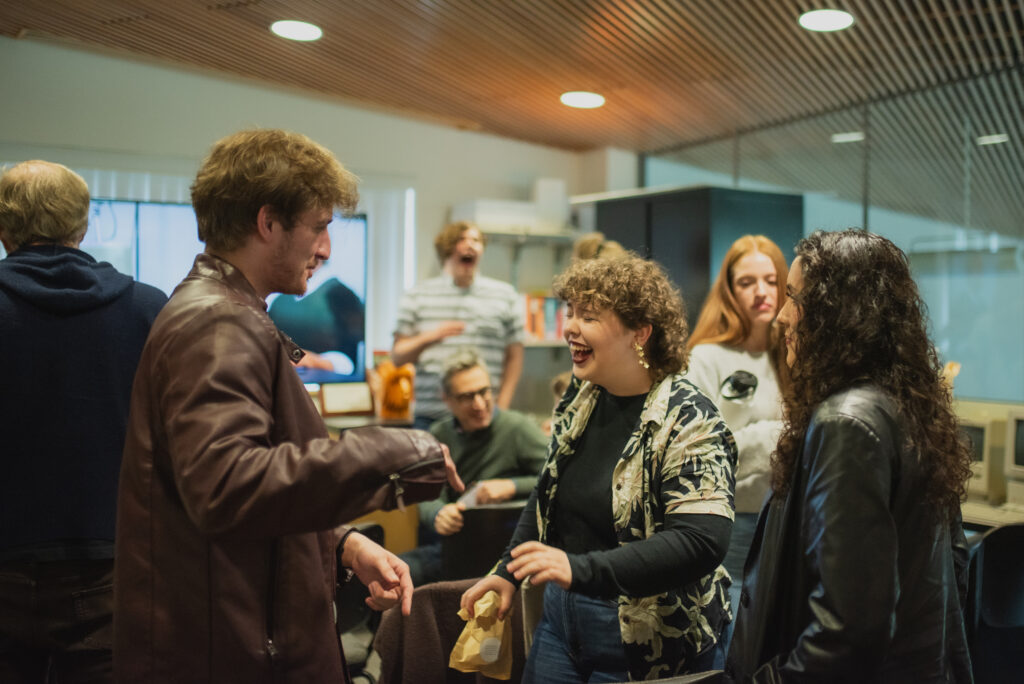
In April of this year, the Electronic Literature Lab celebrated its 15 year anniversary. Started in 2011, the lab’s goal–as described by director and founder Dene Grigar–is to “preserve, document, exhibit and make available . . . born-digital games, literature and art,” work that traces back to the early days when computers first began being used as tools for creative expression.
Much of the lab’s day-to-day work is done by students and former students, several of whom came up through the program Grigar helped build. Grigar explained that the lab also frequently holds exhibitions, and that they do a lot of preservation and reconstruction work–adding that they are one of the only places to do conservation for born-digital works.
Grigar shared that she began this work back in 1991, as a graduate student at the University of Texas in Dallas, studying under a woman called Nancy Kaplan, who was considered one of the top five digital theorists working in the ‘hypertext area’ in the United States. She said that in her time taking that class, it sparked her passion for digital narratives.
She goes on to explain that in 2006, she had a motion tracking lab, and that the technology she was using became outmoded when Microsoft updated its Windows unit. “So I was like, ‘Okay, I’m not gonna be making that art anymore. What do I need to be doing? I need to be saving this art.’” she said.
Pursuant to this goal, in 2011, Grigar founded the Electronic Literature Lab, bringing in her own collection of digital works, including 17 computers–a collection she’d been amassing since she began in 1991. She said that–with the help of a student named Jeff who she described as a ‘Mac geek,’ that she met through her program–she collected around 40 computers to be used for accessing the works in her collection. In 2020, the lab added a museum, which now holds a library of 3,000 works, free and open to the public.
Grigar explained that the work they do is a constant race against a problem she calls “bit rot”–the process by which digital works become unreadable as the software and hardware they were built for age out of existence. Without active intervention, she explained, these works would just be lost to time. She pointed to Eastgate Systems Inc. as an example of when publishers are unable to gather the necessary funding to keep adapting their works to the new systems.
She notes that the Lab is unique in that it holds the original files of the works–unlike the Rhizome organization, who showcase the works, but do not hold onto the original files–and does not require that the original artists maintain their own sites. “I’m holding the works. We maintain the works. We showcase the works. So it’s functioning like a museum and a library. It’s the only one like it.”, she said.
The Electronic Literature Lab can be found at VMMC 211A.
You may also like
-
SW Wash. Locations Accepting Unused Medications for National Drug Take Back Day
-
VSCI Unveils Consolidated Advising Space for WSUV Students
-
Student-Led Organizations: Building Community on Campus
-
Threat or Tool? Professors Weigh-in on AI in the Classroom
-
The WSU Foundation is Holding a Student Art Contest, and Winners Get 500 Dollars Each