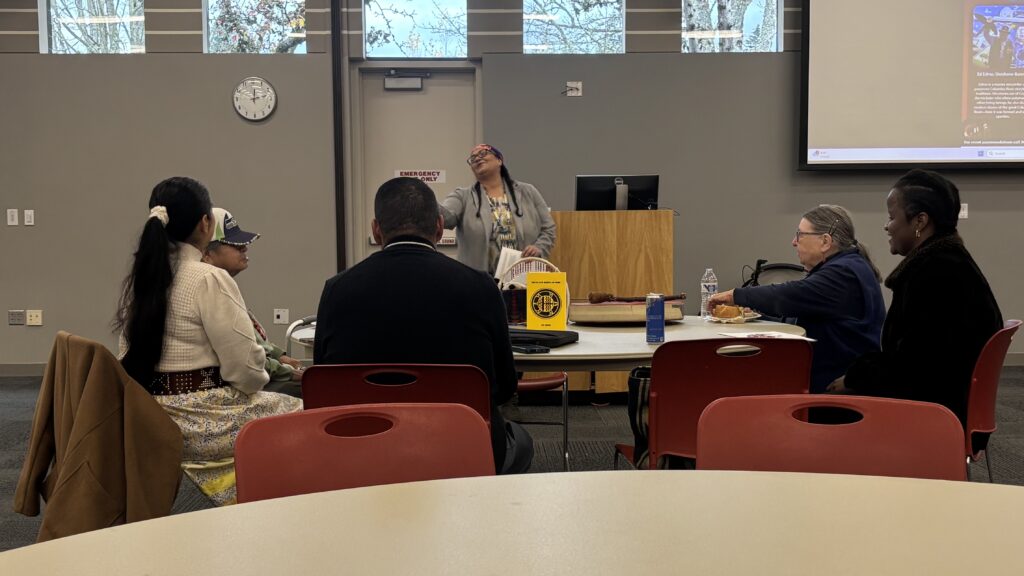
On Nov. 18, Native Programs and CILA hosted a Native American Heritage Storytelling event, in honor of Native American Heritage month. The event featured guest speakers Ed Edmo, Aldo Garcia, and Swan Bybee.
Julian “Julie” Ankney, Director of Native American Programs in the Visiting Writers Series, opened the event. She provided a background on the speakers’ tribal affiliations and work, and touched on WSU’s land grant mission, discussing how the knowledges and cultural influences of Native Americans are embedded into professors’ “teaching, research, scholarship and service.”
Ankney concluded by thanking the Cowichan, Chinook, Nez Perce, Warm Springs, and all of the people of the Lower Columbia Valley.
Aldo Garcia, an enrolled member of the Confederated Tribes of Warm Springs, began his presentation with a song and an explanation of its significance. He explained that the movement accompanying the song–waving one’s hands back and forth–has its own significance.
“Some of the times that means that you’re allowing whatever you hold within yourself, be it joy, happiness, you want to share it. Be it frustrations or depression, anxiety, whatever the world has given you, you want to lay it down on Mother Earth,” Garcia said. “Because all of these songs are living, these songs that we’re singing, and it’s a piece of us that we’d like to share with each and every one of you.”
Concluding the song, Garcia then shared a creation story from the Columbia River Plateau tribes.
In the story, the Creator gave the people a song to express gratitude for the good things in their lives. After the elder who led the songs and ceremonies passed away, the people forgot the song, and the Creator, angered, thusly took away the sun.
Plunged into cold darkness, Garcia explained, the people did not know what exactly they’d done wrong, or how to fix it.
“Because they didn’t realize that that one song, that was all required. Until one day a young warrior was sitting there and he started humming the song. Because these songs are living. And he started remembering it. And it sparked the interest of the other people.”
The people joined the young warrior in song, Garcia explained, and the Creator himself appeared, telling the people that, while they’d be allowed the sun again, they’d only have it for half the day, to teach them a lesson about taking the life they had for granted.
Garcia explained that the story also describes the origins of the seasons and the first foods that sustain the people. Salmon, deer, celery, roots, berries and medicines each offered themselves to provide food and resources throughout the year. He connected the story to present-day traditions, including ceremonies and feasts honoring the first foods of each season.
“To this day, we have a celery season, a celery feast for those first foods that come up. We have a salmon feast for the first salmon that come up the Columbia River,” Garcia said. “We have a root feast after. And then in the summer, we do a huckleberry feast when those are ready. And we give thanks.”
Swan Bybee, an enrolled member of the Nez Perce Tribe, followed with a story titled “Ant and the Yellow Jacket.” In the story, an ant and a yellow jacket argue over a rock near the Clearwater River. Both want to sit on the rock and eat their salmon there, but neither is willing to give way.
The Coyote, who Bybee introduced as a trickster figure in Nez Perce stories, repeatedly tells them to stop fighting and listen. When they ignore him, he turns them both into stone.
Bybee explained that a rock formation near the Clearwater River is said to resemble the two animals still fighting, and explained that the lesson of the story is to listen.
“And so the teaching around that, right, is use your ears,” Bybee said.
Ed Edmo, an enrolled member of the Shoshone-Bannock Tribes and renowned storyteller, shared memories and photos from over the course of his childhood, having grown up in Celilo Village. He also shared a story describing the origin of mosquitos, among other tales his grandmother would tell him, with various moral lessons.
Lastly, Edmo and Ankney both briefly mentioned She Who Watches, a rock carving / painting that looks out on the Columbia River.
You may also like
-
Career Action Center Workshop Gives Tips on Finding a Job On and Off Campus
-
Rockstar’s Grand Re-Opening: Student Thoughts on GTA VI
-
WSUV Teams Compete in Oregon in International Collegiate Programing Competition
-
Afternoon Lockdown Drill Evaluates WSUV Emergency Response with Reduced Staffing
-
“Heavy Helpers” Crafted at Campus Volunteer Event in Support of The Children’s Center