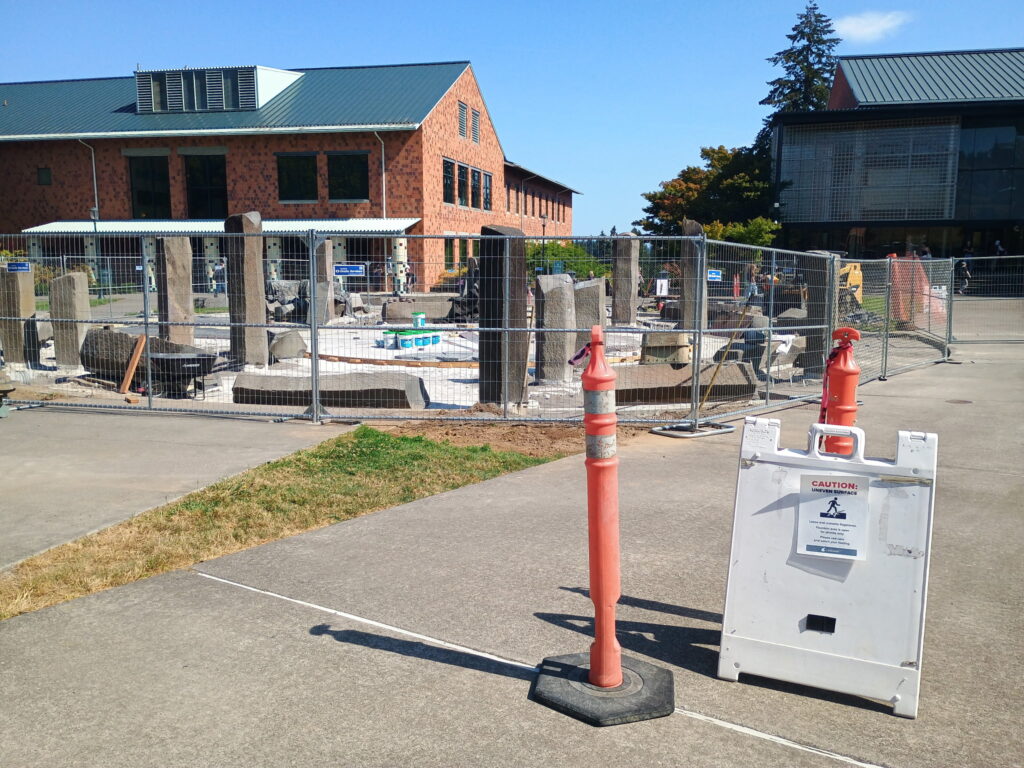
For students returning to WSUV this fall, one of the campus’s most familiar gathering places looks very different. The Firstenburg Family Fountain, normally filled with moving water and surrounded by students, is fenced off as crews complete a major repair project.
The temporary construction zone has prompted questions from students about what happened to the fountain, how much the project will cost, and when the center of campus will feel whole again.
Damien Sinnott, Senior Associate Vice President of Finance and Operations for WSU’s statewide campuses, said the project is intended to restore both the fountain’s function and its role in campus life. Although Sinnott is relatively new to WSUV, he quickly learned how strongly people feel about the space.
“It is a central point that people gather around and form a sense of community and belonging,” Sinnott said.
The fountain was donated by the Firstenburg family over 20 years ago. When WSU accepted the gift, the university also committed to maintaining it over time. Sinnott said the feature has become important not only to students, faculty, and staff, but also to “families in the community who come to campus when the weather is nice.”
The repair project addresses two major problems: a failing water system and an unsafe walking surface.
The fountain is designed to operate as a closed system. Water should flow from the fountain into drains and return to the system to be recirculated. Instead, water was disappearing, reducing pressure, and preventing the fountain from operating consistently. Once workers opened the site, Sinott says they “found a number of broken pipes, which would explain some of the water loss.” He confirmed that they have now been repaired and replaced.
The surface surrounding the fountain had also deteriorated. Pieces of stone had shifted or become loose, leaving an uneven walkway and creating a trip-and-fall risk in an area crossed by pedestrians every day. University officials eventually barricaded the fountain because the pavers were no longer safe.
Sinnott said age and the chemical treatment of Vancouver’s hard water may both have contributed to the deterioration. A deionization system had been installed to reduce mineral deposits on the stone. One theory is that the treated water then sought minerals from the surrounding materials, contributing over time to the breakdown beneath the pavers. Sinnott emphasized that this explanation came from people with technical knowledge of the project and that he was not presenting himself as the expert.
Crews have repaired the pipes and rebuilt the concrete slab supporting the walking surface. New pavers will replace the original slate. While the materials will be different, the new stones were selected to resemble the fountain’s original appearance while providing a safer and more uniform path.
“We are trying to stay as true as possible to the original character of the fountain,” Sinnott said. “It won’t be identical, but it will be pretty close.”
WSU considered other design ideas, including stamped concrete, but learned that option could require more maintenance. Campus representatives consistently favored preserving the fountain’s familiar appearance rather than significantly redesigning it.
“They wanted the fountain repaired and wanted it to look like the fountain they knew,” Sinnott said of the feedback received from faculty and staff. “That was something we heard loud and clear and have tried to do.”
The design and construction project was awarded with a guaranteed maximum price of $470,000 before Washington state sales tax. Sinnott said that amount was intended to serve as the project’s ceiling, although unexpected underground conditions could result in some additional expense. At the time of the interview, he had not received a final cost update.
The project comes as WSU and its campuses are confronting significant financial challenges and budget reductions. Sinnott stressed that the fountain is not being repaired with money from the campus’s regular operating budget.
Instead, WSUV is using carryover funds: one-time dollars saved over time for major needs as they arise. Sinnott stressed that they “want to make sure everyone understands that this project is not being funded out of operational dollars,” he said. “It is not a budget line item that we could have avoided in order not to take a budget reduction.”
The project has involved several parts of the university. WSU’s capital projects team within Facilities Services oversees the work, while a project manager monitors the contractor. WSUV’s facilities employees, budget staff, procurement staff, and development colleagues have also participated. The development team helped ensure the repairs remain consistent with the intention of the Firstenburg family’s original gift.
With initial expectations of being completed before students returned for the Fall semester, Sinnott said the university hoped the fountain would reopen by mid-August, but that goal became unrealistic once work with the contractor began. A later projection anticipated completion during the second week of September.
However, that date has now also been pushed back. The contractor was hoping to finish during the third week of September, but Sinnott said completion could extend to the end of the month. Broken underground pipes and the inadequate condition of the concrete foundation contributed to the delay because their full extent could not be known until crews opened the site.
During construction, pedestrians must walk around the fenced area instead of crossing through the fountain. Sinnott said maintaining accessible routes to campus buildings was a requirement placed on the contractor. The completed project is also expected to improve the surface used by people traveling through the center of campus.
The repairs should reduce the fountain’s water consumption because the new pipes will allow water to recirculate instead of leaking from the system. Sinnott does not expect a major change in energy use. The materials were also chosen with future maintenance needs in mind.
Beyond the pipes, pavers and construction schedule, Sinnott said the project is about restoring a place that helps create the WSUV experience. With its central location, the fountain offers students a place to pause between classes, meet friends, study outside, or simply listen to the water.
“Our campus is ridiculously beautiful, and the fountain is in the center of campus,” he said. “Having something that wasn’t functioning well – or that is now a construction zone – detracts from the experience.”
Sinnott also described the fountain as a source of campus pride and a link between the university and the surrounding community. Restoring it, he said, can encourage visitors to experience the campus and see the work being done by WSUV students, faculty, and staff.
For students wondering why the university chose to make the investment, Sinnott explained the decision followed careful consideration of the fountain’s meaning and the campus community’s desire to see it return.
“We really thought about what the fountain meant and whether it was a good investment for the campus to make to bring it back to life,” he said. “The campus voice told us that it felt differently, and this investment shows that we listened.”
You may also like
-
The WSU Foundation is Holding a Student Art Contest, and Winners Get 500 Dollars Each
-
Annual Professional Clothing Closet Helps Students Dress for Success
-
Your Voice, Your Vote: How WSUV Students Are Approaching the Midterm Elections
-
Exhibit Artists McKinney and Lam Reflect on Family and Their Art
-
Early FAFSA Launch: What Changes and How This Affects Your Financial Aid