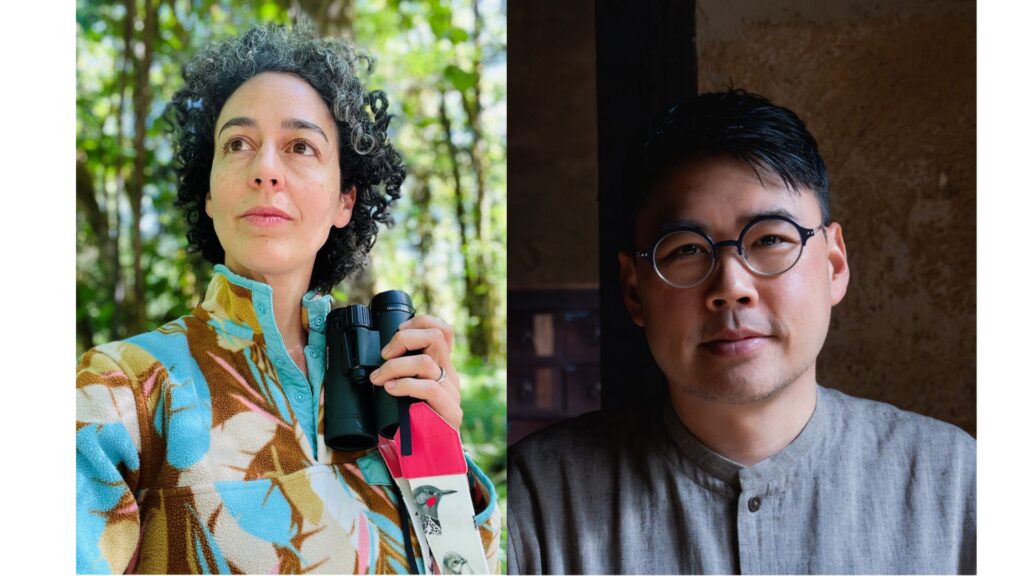
A shirt can hold the memory of someone who once wore it. A familiar food can bring back a family gathering, a childhood celebration or a connection to a place someone has never visited. In the art exhibit “Assembled Inheritance,” artists Kacy McKinney and Cuong Lam explore how ordinary materials carry those experiences forward, even as lives change and loved ones are lost.
Displayed at WSUV’s Dengerink Art Gallery, their textiles and ceramics invite viewers to consider what inheritance means beyond possessions. Their work asks how people remember, how traditions survive and how something left behind can become the beginning of something new.
Kacy McKinney: Fabrics & Grief
For McKinney, that question became deeply personal after her mother died in November 2024.
While going through her mother’s closet, she discovered an unexpected collection of cotton seersucker clothing. She had not remembered seeing her mother wear many of those garments, yet the fabric drew her attention. Its softness and playful character offered something tangible to work with during an unfamiliar experience of grief.
McKinney had already spent years learning to make clothing. Now, those skills became a way to remain connected to her mother. Because they wore different sizes, simply putting on the garments was not an option. Instead, she began cutting them apart and reconstructing them into clothes that fit her body and reflected her style.
Cutting a loved one’s clothing can feel like an irreversible step. For McKinney, it also opened a way to keep that clothing close, allowing remembrance to become something she could wear and carry into everyday life.
That initial process grew into “Mourning Attire,” a book of comics poetry she created in 2025 about losing her mother and transforming her clothes. Her work in the exhibit continues that exploration through patchwork and light, using shirts and other garments found at thrift stores.
The distinction matters: the exhibited panels extend the process that began with her mother’s wardrobe, bringing other materials and their unknown histories into the work.
“I try to preserve everything, while also transforming it into something completely new,” McKinney said.
“In a lot of ways, the works in this exhibition are artifacts of my grieving process; they are about understanding my relationship with grief,” McKinney wrote. “My family does not have a tradition of memorials or death rituals, but this process has been my way of honoring and remembering.”
Her family’s influence reaches beyond the clothes themselves. She described a father whose creativity appeared in carpentry and in combining damaged vehicles into functioning, distinctive cars. Her stepmother continues making art in her 80s. Her mother, McKinney said, faced obstacles that limited opportunities to pursue her own creative interests.
Making art now carries a sense of responsibility: an opportunity to pursue possibilities her mother didn’t have.
Cuong Lam: Sculptures & Family
For Lam, the relationship between family and art began in childhood, when drawing offered a way to communicate before English felt familiar.
Raised in a Vietnamese household in the United States, he entered school without knowing English. Drawing helped him connect with teachers and navigate assignments. Art became a language he could use while developing another.
His family encouraged that creativity. His mother and uncle drew, and his grandfather helped build houses in Vietnam. Lam later studied graphic design and encountered ceramics during his final semester of college. Clay remained part of his life over the following decades before he committed to working with it full time in 2025.
His sculptures draw on objects remembered from childhood, including foods, offerings and figures associated with family expectations.
One work, “Are You Married?,” references the longevity peach. Lam remembers peach-shaped buns filled with lotus paste at cousins’ weddings. The form carries memories of celebration while opening questions about marriage and what those expectations mean to him as a queer person.
Another work, “Do You Have Kids?,” draws from a smiling Buddha figure surrounded by children, an image connected to the importance placed on having a family.
Food remains central to his understanding of inheritance. Although born in the United States, he developed connections to Vietnam through relatives cooking, gathering and sharing meals. Offerings to ancestors created another relationship across generations, one he continues through photographs and offerings to deceased relatives.
His parents and grandparents arrived as refugees, leaving belongings behind. Yet the foods they remembered remained present in his childhood. His sculptures explore how those memories traveled with them and became part of his own life.
At the October 23 campus event, Lam plans a food-memory drawing activity, inviting participants to capture remembered experiences through quick, gestural drawings. He also described Vietnamese food as an important part of the gathering, continuing the connection between sharing food and sharing art.
For McKinney, exhibiting alongside Lam, her dear friend, revealed connections between their work that became especially clear once the pieces were installed together.
You may also like
-
Early FAFSA Launch: What Changes and How This Affects Your Financial Aid
-
The Art of Short Form Video: Tech Workshop Discusses Production and Structure
-
ScreamJam Spirals Into Halloween, as Student Artists and Programmers Team-Up in Month Long “Game Jam” Competition
-
Food for Thought: WSUV Students Reflect on Campus Food Options
-
War in Iran: WSUV Students Reflect on the Conflict