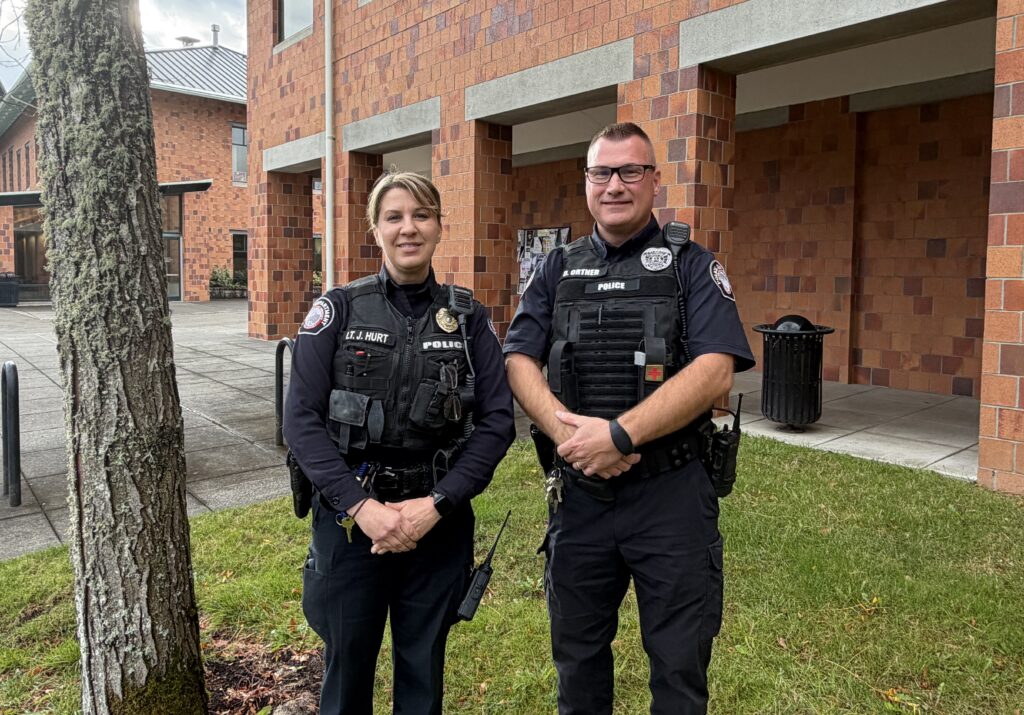
With only two police officers serving WSUV, the Public Safety department’s responsibilities extend beyond responding to emergencies. The department also provides student support, monitors campus property and research areas, and offers services such as safety escorts, jump starts, and vehicle lockouts.
Lieutenant Jeanette Hurt––an officer on campus and the director of Public Safety and Parking Services––and Officer David Ortner, described how their responsibilities differ and how the department works to support the campus community.
Both Hurt and Ortner are certified police officers in Washington state, having gone through extensive training, interviews, and procedures.
“The state of Washington has standards that are very high,” stated Hurt. Along with discussing the rigorous certification processes they’ve been through, Hurt and Ortner explained how Washington state requires them to continue their education through annual training to keep their certification.
Hurt has worked at WSUV for nearly 29 years. She began as a student security officer and later became a police officer and director of the department.
At the beginning of her day, Hurt reviews emails, messages, threat assessments, and student care reports. She also works with the university’s Compliance and Civil Rights office and other departments to coordinate support for students.
Some students come to Public Safety for help with situations involving domestic violence or stalking, even if the incidents occur off campus. Hurt may write police reports, connect students with university and community resources, and continue checking in with them after their initial conversations.
She said supporting students through these situations can involve a long-term commitment, including helping them navigate protection orders and court proceedings.
Hurt also handles administrative responsibilities, including preparing the university’s annual security report and maintaining crime statistics.
Ortner’s work is more focused on monitoring activity around campus. He patrols campus via a vehicle and on foot, checking parking lots, buildings, and other areas for unusual activity.
Before coming to WSUV, Ortner worked for the Washington State Patrol for 26 years. He has since retired and has now been with WSUV for about a year.
His daily responsibilities vary depending on what is happening on campus and in the surrounding area. Through the police radio system, both Ortner and Hurt monitor calls across the county for incidents that could affect WSUV including traffic collisions, road closures, police pursuits, and more.
According to Hurt, the Public Safety department works closely with the Clark County Sheriff’s Office and other local law enforcement agencies. The WSUV officers use the same radio and police reporting systems as other local departments, but their primary responsibility is serving the campus community.
WSUV covers approximately 351 acres, including wooded areas and research sites outside the campus’ main buildings. Hurt said officers monitor these areas to help protect university research and identify problems, such as storm damage or fallen trees.
When they are not responding to calls or completing administrative work, officers also spend time interacting with students, faculty, and staff.
Hurt described this as “managing by walking around.” Rather than having a specific destination, officers sometimes simply walk through campus to act as a safe presence and ultimately be an accessible source of help or information.
Both Hurt and Ortner emphasized that due to the nature of their jobs, their routine varies day-to-day. With a plethora of responsibilities, campus officers never know what each day will bring.
According to Ortner, “in policework, there’s not a quote-unquote ‘typical’ day because you don’t know what kind of calls you’re gonna get.”
Hurt further emphasized this point by explaining that, “I don’t think I’ve ever done the same thing twice in 28 years.”
Even their patrol schedule is subject to change. They explained that varying their routines helps them observe different areas and prevents their movements from becoming predictable.
According to Hurt, the Public Safety department also employs three 24/7 security staff members, one administrative staff member, and four student employees. The student employees, known as student security officers, assist with basic security responsibilities and services for the campus community.
Hurt and Ortner train student employees and help those interested in law enforcement explore career opportunities. Hurt estimated that between 15 and 20 former student employees have gone on to work in law enforcement in some capacity over the past 30 years.
Hurt and Ortner said students may sometimes feel uncomfortable approaching officers in uniform. They emphasized that students can come to them with questions or concerns, even if they do not involve an emergency.
“Even though we’re police officers, our job on this campus isn’t just law enforcement. It’s public safety,” Hurt said.
Hurt also said students who are not comfortable contacting Public Safety directly can share concerns with a trusted faculty or staff member. Reports can be submitted anonymously through the university’s student care reporting process and can help connect students with support.
“We’re here to serve, period,” Hurt said.
You may also like
-
WSUV Sees Rise in Undergraduate Retention Rates, Mirroring the Rest of WSU
-
Ribbon Cutting Introduces the Windstead Lending Library, Named after Former ASWSUV President Jacob Windstead
-
The Spooky Coug Carnival Ratchets Up the Fright with Facepainting, a Pie-Eating Contest, and “Axe” Throwing
-
Parties, Costumes, and Candy: How WSUV Students are Celebrating Halloween
-
Student-Led Organizations: Trapped in Endless Process