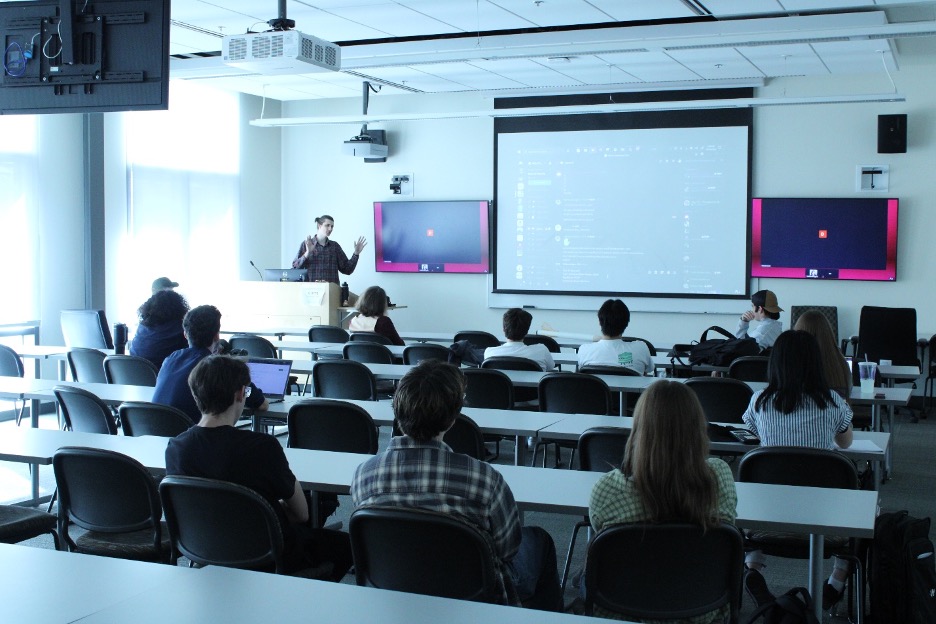
Behind the weekly meetings, competitions, and social events hosted by the many student organizations at WSUV, there is a network of volunteer officers working tirelessly to make it all happen. From establishing budgets and bylaws, to seeking approvals and navigating other bureaucratic hurdles, these students keep campus life lively and engaging beyond the classroom. Yet, while strides have been made toward streamlining these processes, several student leaders on campus believe there is still work to be done.
One point of frustration expressed by club leaders is navigating the paperwork and administrative requirements of student-led organizations.
Koi Li, President of the Association for Computing Machinery – Council on Women in Computing (ACM-W), says they still struggle to find clear guidance on simple tasks.
As they note, “there is not like a handbook that we can just follow,” and much of their time is spent going back and forth with the administration to ask, “is this something we should do?”
Because of significant changes to the process over the last year, they say this is particularly challenging for newcomers, as “you’re like trying to learn a whole different system that was different from last year” and that the previous leadership isn’t familiar with, making continuity and succession a challenge in its own right.
Spencer Bejcek says he spent his first month as president of the Aerospace Club simply learning how the club budgeting process worked; all before exploring other funding streams to cover the more than $20,000 expected expenditures his club will incur this academic year. Part of the challenge is simply determining which funds could be used for particular expenses due to stipulations attached to various funding streams. He notes that different rules apply to money coming through Club Operating Budget (COB), the Student Senate, and external donations. Navigating these processes consume a significant part of his time as club president.
On the administration side, Laurel Crocker, Administrative Assistant at Student Life and Intercultural Learning (SLIL), says the primary resource currently available to student organization leadership is a Microsoft Teams (MS Teams) channel which contains tutorials, information and resources related to club operations and administrative tasks.
“Our student org coordinator created these video tutorials,” says Crocker, detailing topics such as “how to create your budget proposal, how to create your constitution, how to register your event on WSU Involve.”
While these resources may be helpful, other student leaders say MS Teams is not an ideal platform.
“Everyone communicates by email and switching to a chat software is annoying,” says Aidan McCallum, the president of Struggling Engineers. He describes MS Teams as cumbersome and notes that because the program is not widely used in other departments, it becomes yet another piece of software student officers must regularly check. He adds that many notifications end up in spam folders, making important announcements easy to miss.
McCallum does acknowledge that some elements of MS Teams, specifically the automated forms, are helpful. He does not say the same about the software interface behind the Involve app.
“They keep trying to push the Involve app,” he says, lamenting that he has never been able to get it to work properly. He describes the software as cumbersome, with idiosyncrasies that make it a chore to use. Specifically, he cites difficulties with event creation and attendance tracking.
According to McCallum, the software does not allow users to schedule recurring events, while attendance must be recorded during the event itself, which can be difficult to manage during a busy club meeting. He says he is “very unsatisfied” with Involve, to the point that he rarely uses it despite it being the central hub for student organizations.
The MS Teams channel established by SLIL is a new rollout as of this calendar year, according to Crocker. It was designed to alleviate concerns about the budget process last year, but additional improvements are always possible and SLIL welcomes all feedback and always takes it into serious consideration.
“Listening to student feedback” is one of SLIL’s core objectives, Crocker says, emphasizing the department’s commitment to a “student-centered process.” She points to changes within the budget allocation system that went into effect this academic year as an example of the department responding directly to students’ concerns.
“We received a lot of feedback that [the 2025-2026 budget] felt really restrictive,” she says of the previous tiered system. Following surveys and discussions with student leadership, SLIL eliminated the tiers, allowing all registered clubs to request up to $2,500 in funding.
While the shift to an equal cap across the board has resolved some of the issues with the previous tier system, direct funding is not the only resource that student organizations require.
Tristen Carlson is the Chief Mechanical Engineer for Crimson Motorsports, a student club working on the development of a scaled-down Formula Electric competition car. He cites the lack of workspace, as well as liability restrictions, as critical obstacles to the continued development of his club’s project.
Carlson says components of the car and its supporting infrastructure are currently spread between the VECS building, the machine shop, and a closet within the VSSC. The school intends to repurpose the last of these spaces, meaning the chassis and parts stored there must be moved.
While Carlson acknowledges that they were only borrowing the space and notes that it’s fair for the university to ask them to move the chassis and parts, he adds that they haven’t been given a sufficient alternative. He points to WSU Pullman, which fields its own Formula Racing team and has dedicated space for such projects, and he suggests placing an insulated shed in one of the university’s unused fields could be a “relatively cheap” solution.
Bejcek, of the Aerospace Club, also thinks that a dedicated workspace is needed. He says that dedicated space doesn’t need to be a full building, like what is available at Pullman, rather simply repurposes a space that could support assembly work on everything from rockets to robots.
Beyond storage, Carlson notes that the university restricts certain activities, including welding, ostensibly for liability reasons. Working around these restrictions can quickly become expensive, as work is outsourced.
Carlson understands the university’s concerns, joking darkly that “it would look really bad if you had a news title like ‘several students die in horrible welding accident’.” Even so, he wishes there were a way for qualified students to be trusted with machinery, noting that he previously worked as a machinist in the private sector.
McCallum has encountered similar issues. He describes a lack of clear procedures for obtaining approval from the university’s legal and health and safety offices. He points to difficulties securing approval for an “egg drop” competition last year, when there was no clear route to determine what would be permitted and what needed prior authorization.
McCallum is also a part of Crimson Motorsports and says efforts to obtain legal approval to sell donated but unneeded parts to raise money for the project have reached an impasse. According to McCallum, the donor’s agreement permitted the sale of the parts, but the university has expressed concerns about regulations governing the sale of donated items for profit. In this case, he says, what the club needs is a clear process for seeking legal approval.
Bejcek takes this a step further and says because of the scope of the engineering projects that a level of integration into the existing engineering program would be helpful. He suggests that larger projects, which can cost tens of thousands of dollars, might be better served by being tied in with ongoing faculty research projects.
For now, Carlson says his club’s activities are limited to “bringing out some components to talk about and discuss at the meetings”. Without adequate space to work on Crimson Motorsports’ ambitions, there is little more they can do.
You may also like
-
Autumn Fest Brings Warmth, Creativity and Connection to WSUV
-
WSUV Students Discuss Gun Control and Safety Following the Recent School Shooting in Bend, Oregon
-
SW Wash. Locations Accepting Unused Medications for National Drug Take Back Day
-
VSCI Unveils Consolidated Advising Space for WSUV Students
-
Student-Led Organizations: Building Community on Campus