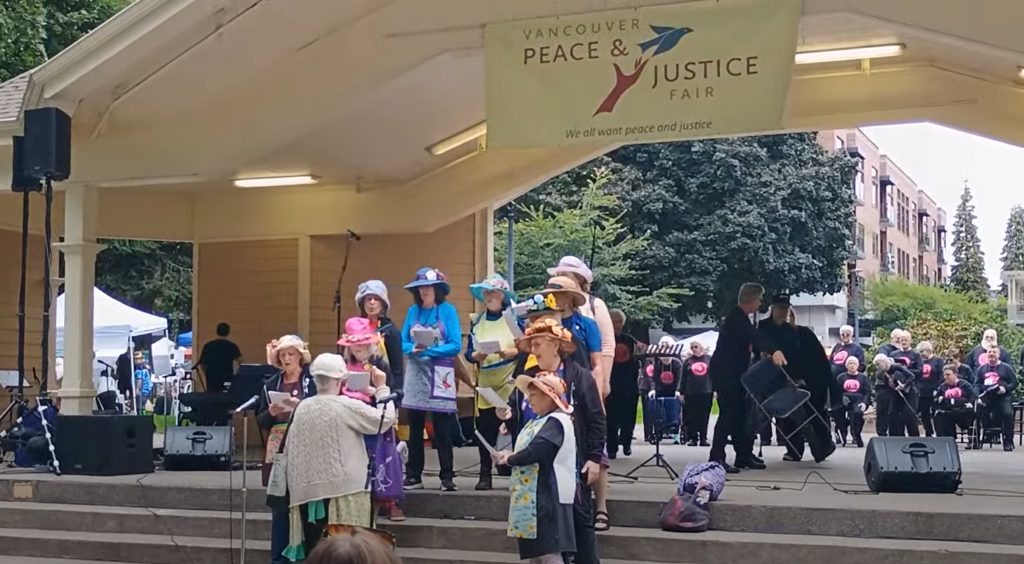
On Saturday, Sept. 12, Esther Short Park became a gathering place for organizations and residents working to make Southwest Washington more peaceful, equitable, and connected. The Vancouver Peace and Justice Fair brought together grassroots organizations addressing a myriad of community concerns such as recovery, homelessness, voting rights, food insecurity, civil rights, disability support, human trafficking, and environmental responsibility.
Held from 9 a.m. to 3 p.m., the annual fair gives visitors opportunities to learn about local resources and discover meaningful ways to volunteer. Its mission is to build connections among peace and justice organizations while highlighting their common goals at home, within the community, and around the world.
Honoring sustained community action
The fair presented its Peace and Justice Hero Award to WSUV Alumna, Sunrise O’Mahoney, in recognition of her environmental and social justice work.
O’Mahoney said she did not know she had been selected until the day of the fair. She began much of her regional activism through the university organization now known as the Collective for Social and Environmental Justice, who was also one of the sponsors of the fair.
The award recognized years of work and reflected the broader message present throughout the park: Lasting community change is created through many individual acts of service.
Creating a place for recovery and belonging
Karen Peterson, cofounder of Couve Collective in downtown Vancouver, described their organization as a community center for “anyone and everyone.”
Couve Collective is part of the Recovery Café Network, but Peterson said its understanding of recovery is intentionally broad. “We believe everyone is in recovery from something, so everyone is welcome,” she explained.
Peterson helped establish the organization because she wanted people to have a place where they could discover their purpose and receive support for long-term recovery. The mission is also personal: Her son has been in recovery from opioid addiction for nearly eight years and is involved with the organization.
Couve Collective needs volunteers on Thursday mornings to assist with showers and on Saturday afternoons to spend time in the café, engage with members, and learn about their needs. As a nonprofit organization, it also depends on community donations.
Strengthening democracy through participation
Mandy Weaver represented the League of Women Voters of Clark County, a nonpartisan organization that promotes voting rights, distributes voter information, and takes positions on legislation without supporting political parties or candidates.
Weaver said she joined because she wanted to become more involved in local and federal governments and take greater responsibility for what was happening in her life.
Community members can attend monthly meetings, become annual members, or volunteer at candidate forums and public events. The organization also visits high schools to connect with students before they become eligible to vote.
Responding to homelessness and hunger
For Nicolette Schweitzer of Share Vancouver, serving people experiencing homelessness is rooted in personal experience.
“I used to be homeless and would come to Share for food assistance,” Schweitzer said. “I wanted to give back to other people who were in need and had been in situations similar to mine.”
Share operates homeless shelters and permanent supportive housing while offering food, housing assistance, and community outreach. The organization accepts donations of food, clothing, and hygiene products. Share is looking for volunteers to assist with distributing hot meals, filling school backpacks, and outreach programs.
Food access was also a central concern for Rachel Emmer of the Clark County Food Bank. The organization distributes food through approximately 50 partner agencies, including the WSUV Cougar Pantry (read more about this new partnership here). According to Emmer, the food bank sends more than 11 million pounds of food into the community annually.
Emmer said her work is focused on reducing waste, making the best use of available food, and ensuring it reaches people who are hungry. That work relies heavily on volunteers.
“Volunteering is our lifeblood,” she said, explaining that more than 4,800 people volunteer with the organization during a typical year.
Building solidarity and resisting injustice
Kathleen Proudfoot represented 50501 Clark County Washington, a grassroots volunteer organization focused on community solidarity and mutual aid. Proudfoot said the group connects residents with existing organizations and resources while responding to changing community needs.
Its work includes supporting food-distribution networks, sharing fresh-food resources, and helping people connect with local mutual-aid services. Members are also becoming more involved in local government by attending city and county council meetings and participating in neighborhood and political organizations.
Proudfoot said the group welcomes many forms of participation, including music, poetry, visual art, medical experience, and other practical skills. It works with organizations such as Free Fridge to redirect surplus resources to people who can use them.
The group also distributes free water and snacks at its events, saying, “we believe food is a human right. We want people to feel joyful, and food is one way we can connect with one another.”
Supporting survivors and advancing civil rights
Alicia Laing of the Human Trafficking Task Force of Clark County said the organization works to educate the public, empower survivors and advocate for people affected by trafficking.
Laing became involved after encountering trafficking-related needs while working as an emergency department nurse. She recognized gaps in available support and wanted to help connect survivors with resources.
Community members can participate by attending the task force’s monthly meetings, completing educational trainings, volunteering at events, and becoming more aware of trafficking within the region.
Daniel Estrada, president of Vancouver Metro LULAC, discussed the organization’s work to advance education, economic opportunity, housing access, public health, political participation and civil rights for Latino community members.
Estrada said public service has shaped his life both as a recipient of community services and as an educator. Issues such as food insecurity and immigration advocacy remain especially meaningful to him.
LULAC offers free youth sports and extracurricular activities at Marshall Park on most Sundays from 5 to 7 p.m. Older participants can develop coaching, leadership and mentoring skills. Estrada also highlighted No Sabo, a Spanish-immersion conversation group hosted at Dandelion Teahouse where participants can practice speaking Spanish through games and informal conversation.
Making inclusion accessible to families
Maria Canedo represented Pasitos Gigantes, an organization supporting Hispanic families whose children have intellectual disabilities, autism, ADHD, or Down syndrome.
Canedo found the organization in 2021 while looking for support for her own child. She first became a volunteer and later joined the staff.
She encouraged residents to share information about Pasitos Gigantes so more families can learn about its services. Volunteers can also assist at events by serving food, helping with cleanup, and supporting other community activities.
Sharing resources within communities
The fair also introduced visitors to the Vancouver WA Tool Library, a new community-powered resource represented by Janice Rasmussen. The organization is based on a simple idea: Communities already possess an abundance of tools, but not everyone has equal access to them.
By gathering tools in one location and allowing residents to borrow them for free, the library hopes to reduce unnecessary purchases while making household and community projects more affordable. Rasmussen said approximately a dozen organizers have spent the past 18 months building the program. It is seeking volunteers, borrowers, and residents willing to share tools.
“We want to help everybody collaborate so that we all have access to more,” Rasmussen said.
Environmental responsibility was also emphasized by Doug Ballou of the Salmon Creek Lions Club. Its recently created environmental branch focuses on recycling education, tree planting, park restoration, and related service projects.
Ballou, who has been a Lion for nearly 30 years, encouraged residents to learn which materials can be recycled locally and how discarded items can be reused. He said the club welcomes volunteers who want to make a larger environmental impact.
From helping a person obtain food to teaching a young voter, supporting a trafficking survivor or lending a neighbor a tool, each organization offered residents a practical way to participate. Together, they showed that peace and justice are built when people share their resources, experiences, and time with one another.
You may also like
-
WSUV Art Exhibition Explores the Connections of Inheritance and Memory
-
From Registration to Representation: Helping Students Make Their Voices Heard
-
Partnership Incoming: WSU Integrating Google AI Tools
-
Students Work to Restore and Preserve Digital Games, Art and Literature at the Electronic Literature Lab
-
Goats, Candidates, and Civic Engagement Come to WSUV