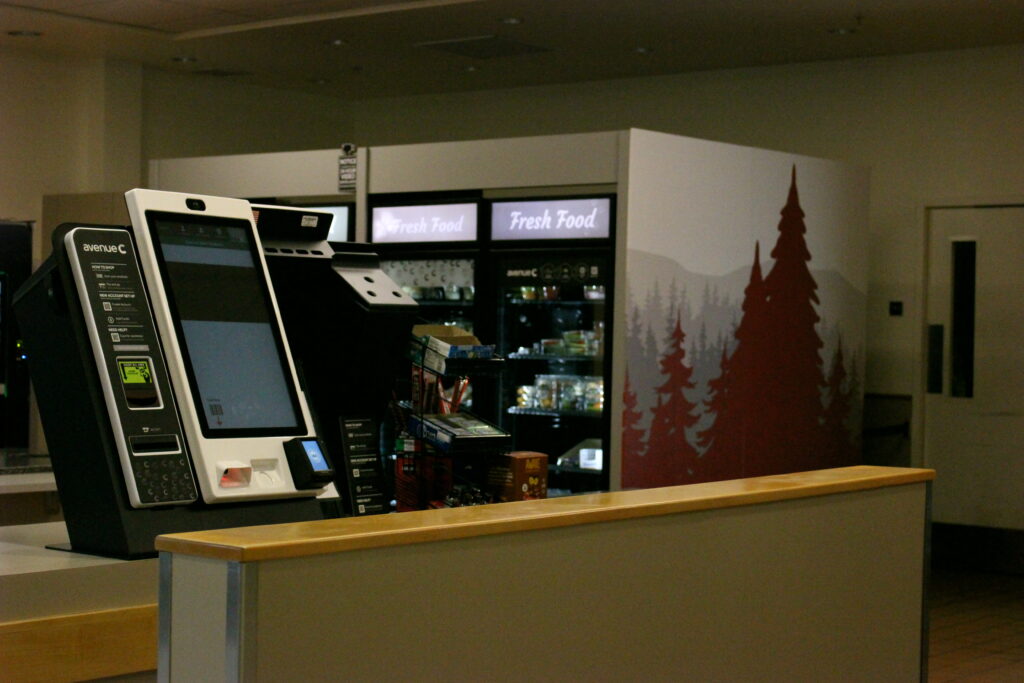
Fresh food on campus is not a new topic of concern among students, but the possibility of a fresh food cafe appears to be off the table, as the prior model is financially unfeasible and WSUV has to explore new options.
On February 4th, a protest was held in response to the swearing in of Officer David Ortner. While not the focal point of the protest, some protestors questioned why the funding that went to hiring Ortner couldn’t have gone to helping fund a cafe for fresh food. Vice Chancellor for Finance and Operations Damien Sinnott said that is not possible.
“WSU policy doesn’t allow us to use state funding to subsidize an auxiliary type of service,” he said. “A service that we charge for, that customers come to and buy things, has to be self-sustaining. We can’t use operating funds, can’t subsidize it in that way.”
According to Sinnott, the cafe model that existed prior to the COVID-19 pandemic was already financially strained before it closed. Meanwhile, with a smaller student population and fewer faculty and staff regularly on campus today means that reopening the same cafe would likely face the same challenges. Sinnott believes that the price points high enough to cover costs would not make sense for potential customers.
Sinnott said the campus may need to “think outside the box” when it comes to possible solutions. He referenced the two models used on the Pullman campus, one including food as part of housing and dining, the other including commercial entities setting up at the food court.
“So it’s self-sustaining in that way. It has no state allocation, no operational funding goes to support that. Truly self-sustaining,” Sinnott said.
However, according to Sinnott, in a largely commuter-based campus like WSUV, replicating either model presents challenges. Without a residential student population purchasing meal plans, there is no built-in revenue stream to guarantee steady income for a dining operation. And with fewer students present on campus throughout the day, attracting outside commercial vendors may not be financially viable.
When asked about funding food options through student fees, Sinnott said it is possible. Sinnott cited WSU Tri-Cities, where students operate a coffee shop subsidized in part through student fees. The shop offers limited food options but does not function as a fully self-sustaining model. He emphasized that such a decision would require collaboration with student leadership.
Sinnott said that since arriving on campus last August, he consistently hears two concerns raised by students: parking and food service. While funding restrictions limit certain approaches, he said working collaboratively to find a solution remains a priority. “I think it’s a real issue,” he said. “I think it’s a real concern. And I think it’s going to take a collaborative effort between the campus and the students to try to figure out some solutions to address it.”
You may also like
-
Threat or Tool? Professors Weigh-in on AI in the Classroom
-
The WSU Foundation is Holding a Student Art Contest, and Winners Get 500 Dollars Each
-
Annual Professional Clothing Closet Helps Students Dress for Success
-
Your Voice, Your Vote: How WSUV Students Are Approaching the Midterm Elections
-
Exhibit Artists McKinney and Lam Reflect on Family and Their Art