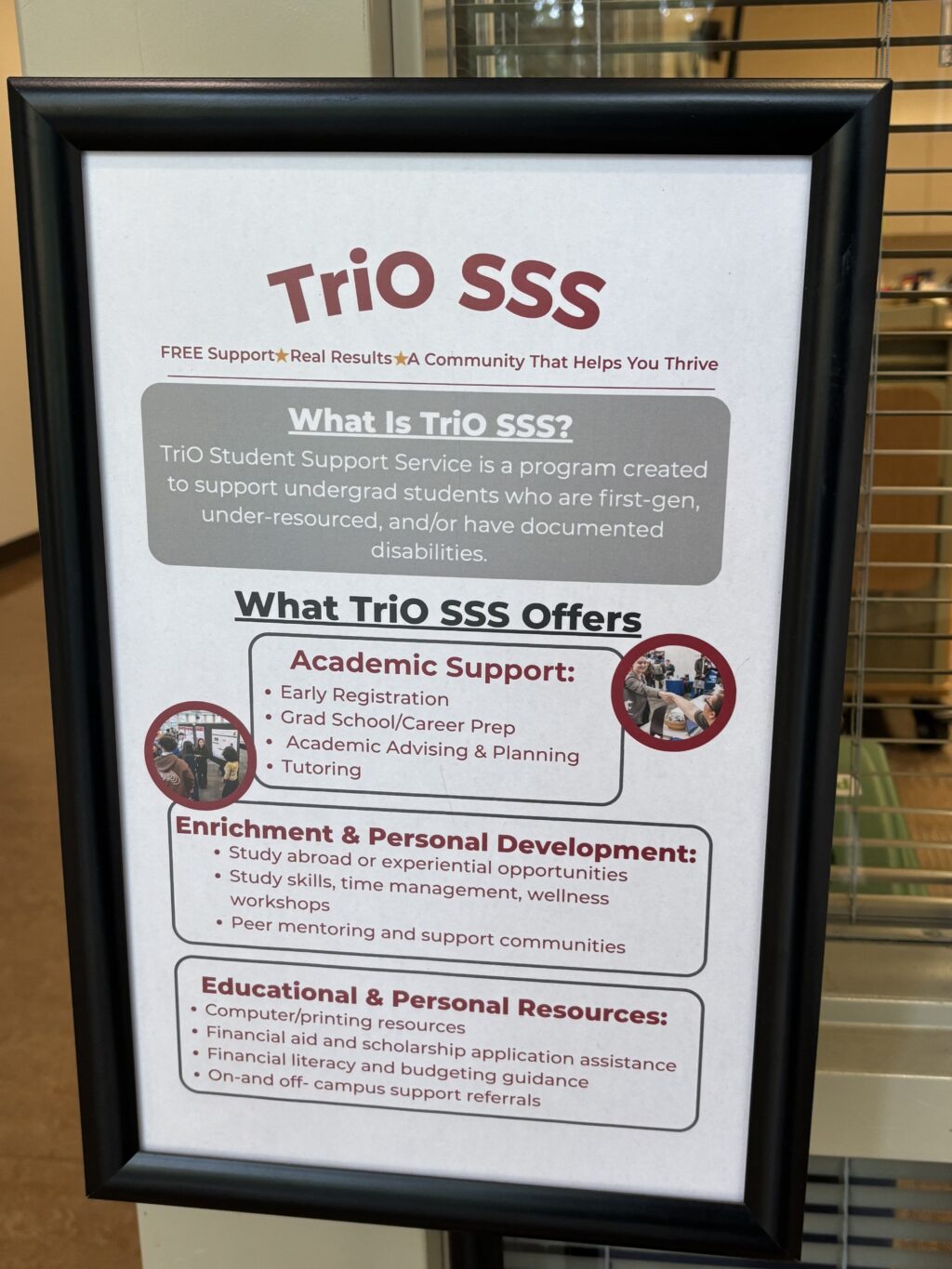
Amidst a lack of answers regarding the Community and Collaboration Office (formerly the DEI office), WSUV is gearing up a new office in the same space, called TRiO-SSS (Student Support Services).
Starting at the beginning of 2025, WSU and WSUV started to scrub mentions of DEI from their language and websites. On January 20 of 2026, a “Campus FYI” email sent to the entire WSUV student body announced that the university was naming Elisha Hardekopf the Campus Director for the newly-formed TRiO-SSS program.
Hadekopf provided no comment on the state of the Community and Collaboration office. Recently, it was suggested in an Administrative Services Review that the Community and Collaboration office needs to work on articulating its purpose and impact.
Funding for TRiO-SSS has been revoked from colleges across the country. According to the President of The Council for Opportunity and Education, the majority of cancelled TRiO-SSS programs all referenced or had connections to DEI.
According to Hardekopf, the grant for WSUV was approved (somewhere between September and November) during the same time as other TRiO-SSS Grants were getting slashed.
When asked whether WSUV scrubbing DEI language from its sites may have helped with getting funding for TRiO-SSS, Hardekopf was not able to clarify.
“I can’t answer that. When I look at the grant and I look at what got it approved, a lot of first generation, a lot of low income, a lot of students with disabilities, that’s what I saw in the grant,” Hardkopf said. “I didn’t see anything about DEI or lack thereof. It was about the fact that there’s a need for the services.”
In a Budget Proposal for 2026, the Office of the Executive said that TRiO-SSS and similar programs “are a relic of the past when financial incentives were needed to motivate Institutions of Higher Education.”
The Office of the Executive said that colleges should be using their own resources to engage with the community, and aid the success of students, rather than “engaging in woke ideology with Federal taxpayer subsidies”.
In September, Washington state joined a lawsuit with the Council for Opportunity in Education. 3 different Washington state colleges were named in the lawsuit (Green River College, South Seattle College, and Big Bend Community College, the latter of which had 2 TRiO-SSS programs.)
When asked why WSUV received the grant while many others were getting slashed, Hardekopf explained it was due to the high number of first generation students and that WSUV was originally established to be a university with a high amount of research.
“We do have a lot of first generation [students]. And the point is that WSUV was established to be a source of R1 attainment [universities prioritize groundbreaking research and high-level, funded scholarly activity] in this region. There’s not really any other place in Southwest Washington that does that,” Hardekopf said. “And so, yeah, knowing that we have a lot of first generation families coming in.”
As it stands, it is unclear what will happen to the Office of Community and Collaboration. TRiO-SSS is moving into the same office space, with limited availability and pre-requisites. Unlike the DEI office, there is no explicitly stated clear support for POC or queer students. It is unclear whether any vestiges of the former DEI office will remain in whatever program takes its place.
When asked in a previous interview if Interim Chancellor Sandra Haynes supported DEI, Haynes said that “We are fully committed to access and opportunity on this campus. We do not discriminate with race, color, religion, national origin, sex.”
You may also like
-
Rising Costs and No Sense of Community on Campus. Students Offer Feedback to WSU President Elizabeth Cantwell at Recent Listening Session
-
New Coug Orientation Goes Through a Revolution, As a Result of WSU’s Systemwide Reforms
-
The Silent Voices: A Chance to Tell Their Side
-
“Terrible” and “Complicated.” Students React to Trump’s State of the Union Address
-
Impressions of a WSUV Douglas Fir