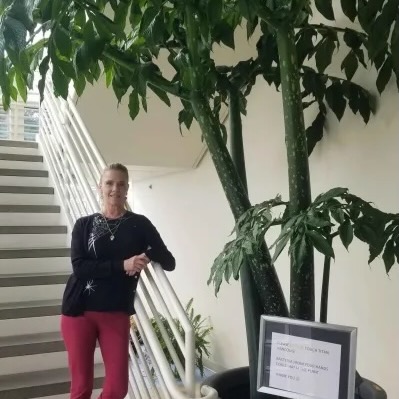
Walking through The Science and Engineering building at WSU-V reveals lab rooms which have been stocked, organized and cleaned, as well as real plants nurtured in the greenhouse and hallways with impressive growth, and all of this has been done by Dawn Freeman.
Freeman is the Instruction and Classroom Support Technician for the building, and has been supporting the university’s science program for nearly two decades now, after studying at WSU-V from 2006 to 2010 and getting a biology degree. She decided to study at WSU-V after advancements in technology cost her a previous role as a Medical Transcriptionist, which is someone who listens to voice notes from doctors and transcribes them into written notes for future use.
“I loved it, but technology, as it is, booted me out of my job the way that I liked it,” she said. “ Now you see doctors doing it themselves or talking into a template. So I thought, well, I like medical stories, I’ll do something in the medical field”
Through her four years studying, she struggled with the differences between a four year university like WSU and the community colleges she attended previously.
“I cried the entire first year, and then the requirements to be a pharmacist changed and you had to get a philosophy degree, a PhD, and four years just about killed me.”
Dawn found herself initially drawn into the world of biological research by working in Dr John Harrison’s biogeochemistry lab, where she immediately was put to work identifying cyanobacteria in samples from Lackamas Lake, studying nitrogen cycles, as well as running instruments for him and other staff in his lab.
“So that was fun. I got to work on the microscope, and now I’m completely enamored with microbes all the time. And it helped me network more, that’s how I found out about the job opening I got.”
When Freeman was graduating in 2010 jobs in this field were scarce. “A lot of people I graduated with went back into the restaurant business, so I felt lucky to get a job. Plus it’s a beautiful campus and I know the people.”
She started as the assistant to her current position, and within two weeks her mentor left, leaving Freeman on her own to figure out how to do the work.And so Dawn was swept into the position she still holds today, working in the greenhouse growing plants for the classes and cleaning the classrooms.
In the nearly two decades she’s been here, Dawn has seen the campus go through many beneficial changes. “In our old chem building there were no windows, it had bad ventilation. We crammed 24 students in a room built for 14. Now I’ve got a view of Mt. St. Helens on a clear day. It changes how you feel about coming to work.”
Beyond working in the labs and the greenhouse, Freeman organizes budget fees, attends back-to-back meetings, and sometimes takes up the front desk. She also sits on the President’s Commission on the Status of Women as a Public Relations Liaison, a system wide association that runs the Women of Distinction as well as the Women of the Year awards.
“When you’ve been here for 20 years you just start picking up on the odd jobs list.”
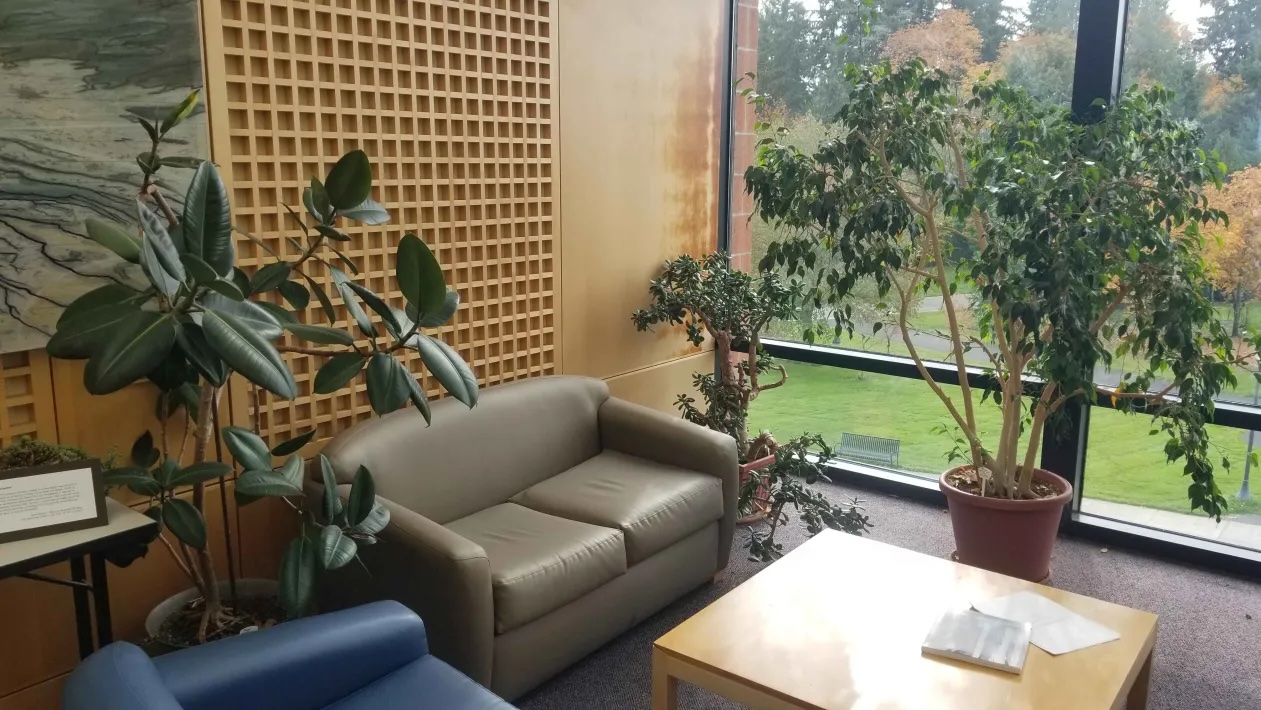
Though only contractually obligated to care for the corpse flower, as well as the geraniums she grows for the biology class, she also watches over the plants in the upstairs atrium on her own time, after they were abandoned by the previous caretaker.
There’s Ficus Elastica and Ficus Benjamina trees, a Crassula Ovata aka a Jade Plant, and a Dieffenbachia that once burned her hands while she was pruning it.
“I was up there in the atrium and a leaf was brown, so I grabbed it and it stuck to my hand. I pulled another leaf and my hands instantly started burning. I tried to wash it off but they’re full of oxalic acid, and for a month I had an itching burn on my hand until the skin peeled off. So for some plants I learned the hard way.”
“They all have their own little story.”
Some are stories of triumphs, like when she rescued a beautiful amaryllis flower that had been abandoned in the foyer, and some are stories that end in shambles. The Avocado tree, donated to the university, ended up being overwatered until it began to rot.
She needed another person helping her to haul it outside to dump. And among it all Dawn is constantly battling scale, spider mites, or overgrowth in her plants.
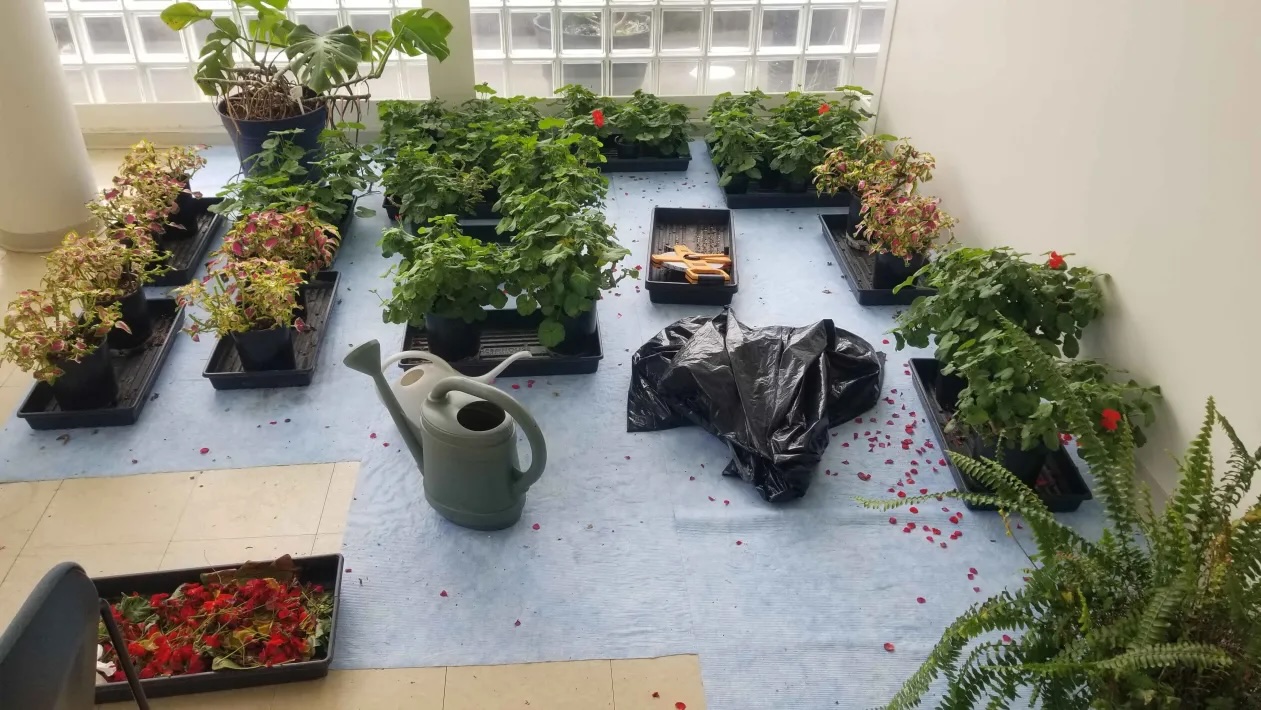
But most of the plants Dawn grows earn their keep. The many Geraniums Dawn grows are used for teaching the Biology 106 and 107 classes, where they are used for demonstrating photosynthesis and plant anatomy.
The Orchids and amaryllis she grows are placed in the upstairs atrium only when they’re blooming so that students and staff passing by can enjoy them at their most beautiful.
“But mostly, things just stay where they are because that’s where they grow best.”
The most notable of the plants Fremman takes care of is the corpse flower, named Titan. The corpse flower was initially taken care of by Steve Sylvester between 2002 and 2019, who initially planted the seed. The corpse flower is a unique plant which mainly grows in the wild on a single mountainside in Sumatra, while Titan thrives with towering leaves under fluorescent lights and an air vent in the cold state of Washington.
In the present day, Titan blooms with an almost random frequency, then stays dormant for long periods of time, and it might not be a single flower at all anymore. The convention for a corpse flower is that a corm (the underground stem) can only hold one leaf or bloom at a time, but Titan defies conventions. This corpse flower now has four leaves all on their own time cycle now.
The only other recorded instance of a corpse flower having multiple leaves comes from eastern Illinois, where a corpse flower sharing the same parents as Titan has produced several outcroppings, all with more than one leaf.
It remains unclear whether this is a genetic anomaly, or a hereditary trait that happened to present itself in Titan and its sibling. Anytime there is a plan to lift the pot and examine the corm, the plan is foiled by new growth.
“Once we lift it, we’ll see what’s really happening under there. Maybe it’s more than one plant, maybe we can split it and give one to the Pullman campus, or the Cowlitz tribe, maybe even San Diego.” And that truly is the goal with caring for Titan, to keep it alive, learn from it, and share it with as many people as we can. We could learn so much.
You may also like
-
Rising Costs and No Sense of Community on Campus. Students Offer Feedback to WSU President Elizabeth Cantwell at Recent Listening Session
-
New Coug Orientation Goes Through a Revolution, As a Result of WSU’s Systemwide Reforms
-
The Silent Voices: A Chance to Tell Their Side
-
“Terrible” and “Complicated.” Students React to Trump’s State of the Union Address
-
Impressions of a WSUV Douglas Fir