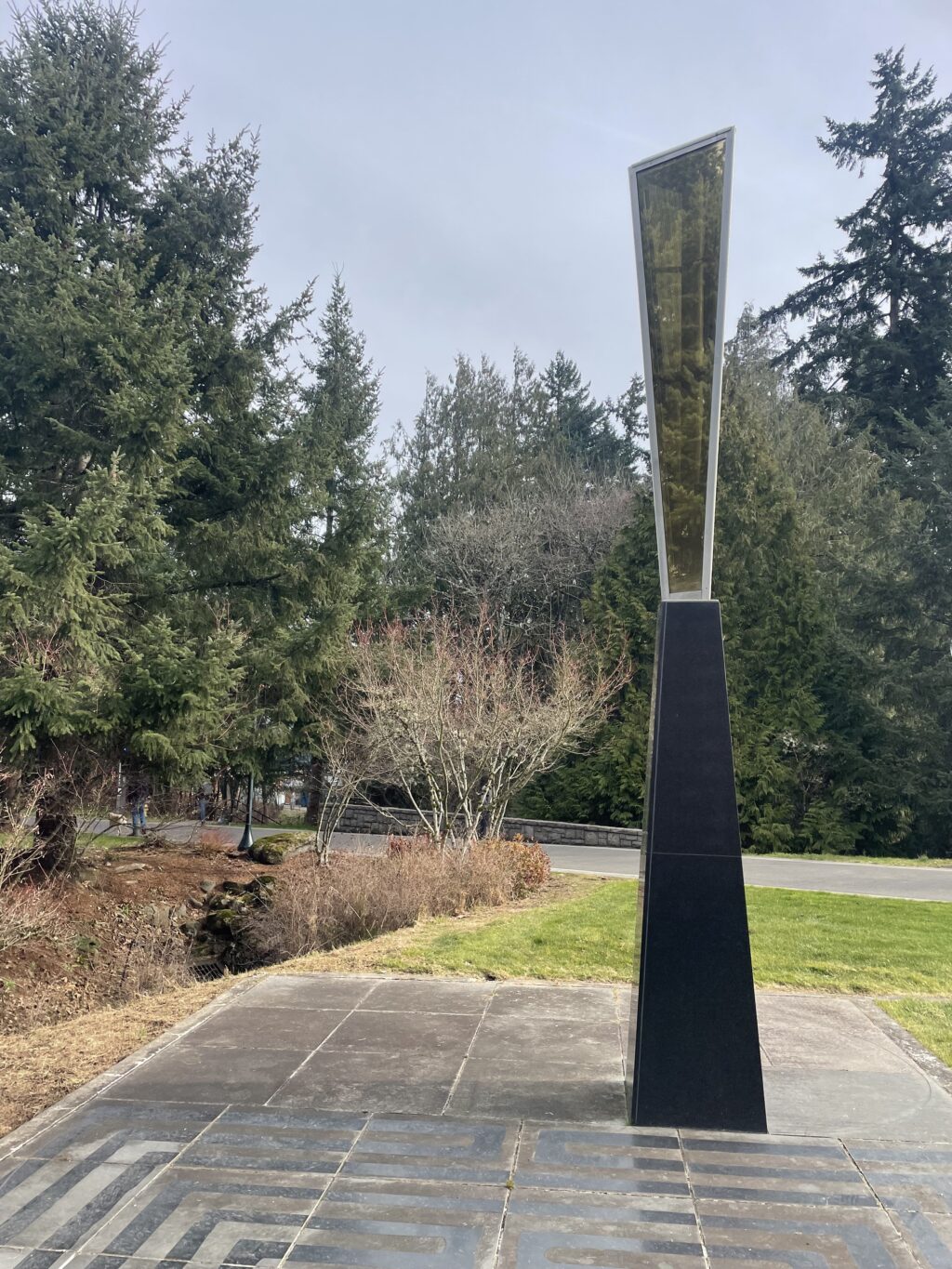
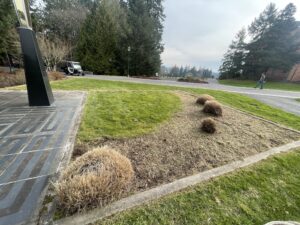
Standing atop a concrete pad at the intersection of three main walking paths outside the Firstenburg Student Commons stands a tall golden sculpture. Next to the concrete pad, a simple plant bed with a few bushes curves around a grass patch in the shape of the Fibonacci spiral.
The golden sculpture, entitled “Golden Section,” was created by a Los-Angeles based artist named Michael Davis, and the sculpture is meant to be representative of the intersections between art and nature.
The monument stands at a towering 16-foot high; the lower half is composed of granite, and the upper half is composed of a tri-sided golden glass structure enclosed in stainless steel. The glass at the upper half of the tower lets sunlight through, acting as a sundial.
The installation’s title refers to the Golden Ratio, sometimes referred to as the Golden Section. In art, this ratio is used to create compelling compositional arrangements in various media types. In nature, the Golden Ratio can be seen in seed patterning of different flowers, seashells, and trees, and elsewhere.
Some may also know this as the Fibonacci spiral, a spiraling shape that grows exponentially as it radiates out. This can be seen in the distance between the plants in the plant bed.
For those too busy heading to class to look around much, they may miss it entirely, partially because it’s out of the way and normal view of the pathways. It’s kind of just . . . there.
However, it’s a piece of artwork that’s been on campus for some time, created in 2003.
On the concrete pad below, an inscribed labyrinth pattern covers the majority of the installation. Over the entire plaza, the Fibonacci spiral is etched, and at the labyrinth center, a swirling spiral. There is no plaque describing the artwork, resulting in a piece of art that draws more questions than answers.
According to Davis, the labyrinth pattern etched into the plaza is representative of the intersection of different disciplines “integral to the foundation of liberal arts institution” and highlights the function of the university as a means of bringing together different people with different ideas and values to “create a dialog of intellectual discovery.“
Meanwhile, looking at a campus map will show that the location of the structure lies at the center of campus, about equidistant between both ends of the school. It also lies at the intersection of multiple popular walking paths.
Was this an intentional creative choice? One that highlights the value of the intersection of different values and ideas?
The choice of using a sundial itself also showcases, from a literal perspective, the intersection of “geometric order and the phenomena of light and time.”, adding another layer of meaning.
Despite the mystery behind the installation and its ideas; the coming together of different personalities, beliefs, and thought processes, combined with the either intentional or unintentional location at the center of campus, amidst an intersection of pathways, emphasizes the links between art and nature that is both spatial and physical.
You may also like
-
Rising Costs and No Sense of Community on Campus. Students Offer Feedback to WSU President Elizabeth Cantwell at Recent Listening Session
-
New Coug Orientation Goes Through a Revolution, As a Result of WSU’s Systemwide Reforms
-
The Silent Voices: A Chance to Tell Their Side
-
“Terrible” and “Complicated.” Students React to Trump’s State of the Union Address
-
Impressions of a WSUV Douglas Fir