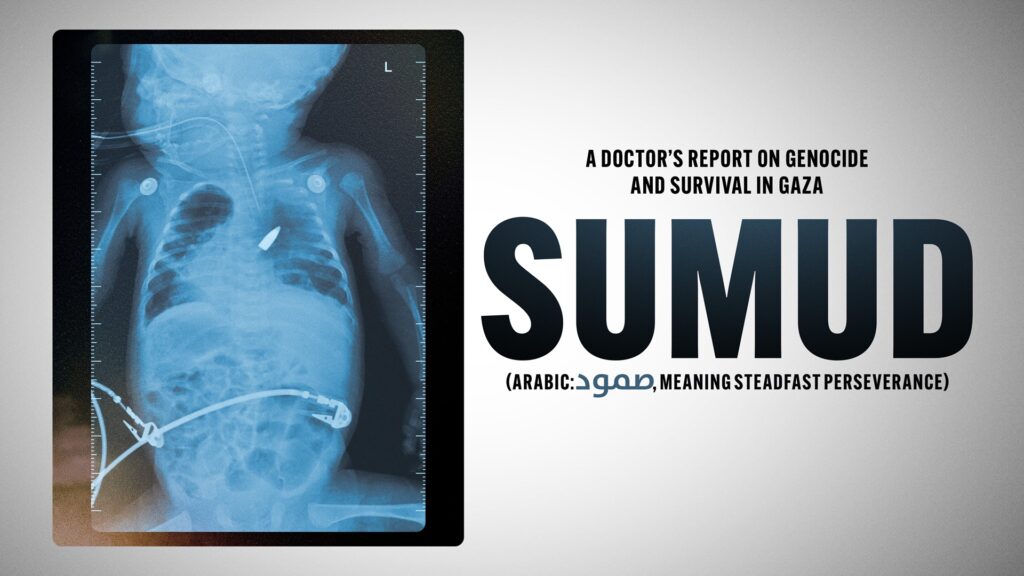
“Sumud” is the closest English analogy to steadfastness, “this notion of standing your ground, of withstanding,” director Jan Haaken said during a recent talk at WSU Vancouver.
The Collective for Social and Environmental Justice, TGLIP, and DocArts Series held a screening of Sumud: A Doctor’s Report on Genocide and Survival in Gaza. The screening was hosted through the CSEJ, Native American Programs, the Center for Intercultural Learning and Affirmation, and the Council for Community Engagement, Dialogue, and Impact.
The film is free and open to the public, and the screening was followed by a talk with the film’s director, Jan Haaken, professor emeritus of psychology at Portland State University and documentary filmmaker.
The screening centered on the medical workers, journalists, and civilians continuing to endure under siege in Gaza. Haaken explained during the discussion that the film emerged out of conversations with healthcare workers for Palestine and out of the concerns raised in her earlier documentary, The Palestine Exception, which explored retaliation and censorship surrounding speech on Palestine.
The film follows a Portland-based anesthesiologist who volunteered in Gaza, Dr. Travis Meleen. Throughout the film, viewers witness doctors treating mass casualties in overwhelmed hospitals with limited resources.
Meleen notes that many of the tools normally used in emergency rooms were unavailable, leaving doctors to rely on clinical observation alone. Equipment was old, damaged, or patched together, and sterilization was nearly impossible during constant mass casualty events, meanwhile medications were also scarce.
While previous volunteer missions would have seen primarily injuries caused by explosive weapons, many of the patients Meleen treated had gunshot wounds. The wounds often appeared precise and deliberate, sometimes targeting the head, chest, or femoral artery. According to Meleen, many victims arrived from aid distribution sites, predetermined locations where civilians gathered for food and supplies while risking being shot.
The film also includes reflections from journalist, activist, and award-winning author Omar El Akkad. For El Akkad, the images and experiences documented in Gaza make it impossible to return to the same frameworks or justifications often used in political discussions. His commentary challenges viewers to confront not only the violence shown on screen but also the narratives that attempt to explain or minimize it.
“I’ve seen enough bullets lodged in enough children’s heads,” El Akkad says in the film. “There is nothing you are going to tell me that’s going to bring me back in line.”
El Akkad also questions the language often used when discussing communities facing violence and hardship. In the film, he reflects on the common praise of resilience.
“I have a difficult relationship with the idea of resilience,” he explains. “I don’t want to live in a world where children are described as resilient.”
“There’s nothing complicated about the situation,” Haaken said, referring to the silence from U.S. medical institutions. “It’s very clear and obvious genocide.”
Haaken reflected on Omar El Akkad’s complication of the idea of “resilience.” Where resilience is often praised, he suggests that it can also become part of a colonial framework where suffering is normalized. In that sense, sumud becomes a political term which does not celebrate suffering, but names persistence through it.
From the beginning, Haaken said she did not want the documentary to frame Meleen as the hero, instead wanting to keep Palestinian healthcare teams and patients central. In describing the process, she said the film was built around relationships, trust, and careful thought about how suffering is shown on screen.
A major theme of the talk was the ethics of using images from spaces of trauma and the responsibility of not reducing people to spectacle. Haaken explained that just because an image exists online does not make it ethical to use, especially when people are captured at the end of their lives or in moments of extreme vulnerability.
When interviewed after the event, WSUV student Sofia Lane said the documentary expanded her understanding of Gaza by showing both the violence itself and the structures surrounding it.
“I feel like there’s this very intense rhetoric that goes along with the physical violence,” Lane said. “A very violent rhetoric of enforcing this fabricated paranoia to create an enemy that isn’t actually there.”
Lane said one of the most difficult parts of the film was seeing how even medical tools and basic supplies are withheld from institutions whose entire purpose is to care for people. For her, the film made clear that the destruction is not random but calculated.
“I think it goes to show how calculated and scaled it is,” she said. “It’s something that is allowed to keep happening.”
Haaken said she hoped the film would not only leave audiences with shock, but also space to remain present with what they had seen, rather than immediately shutting down. She didn’t want viewers to feel they couldn’t do anything about it, emphasizing that one lesson of the film is that care, action, and solidarity are part of how people hold onto their humanity.
The talk did not attempt to offer easy reassurance. It is about the refusal to disappear, the insistence on dignity, and the effort to keep speaking even when institutions remain silent, and to raise awareness about restrictions on humanitarian aid entering Gaza, impacting Palestinians.
You may also like
-
WSUV Wellness Center Had 30 to 40 Percent Less Counseling Visits Last Semester
-
Hot Food Options for WSUV Not Likely to Return Until Fall 2026 at the Earliest
-
Taililo Marfil and Yolotil X Speak on Activism Through the Arts
-
Rising Costs and No Sense of Community on Campus. Students Offer Feedback to WSU President Elizabeth Cantwell at Recent Listening Session
-
New Coug Orientation Goes Through a Revolution, As a Result of WSU’s Systemwide Reforms