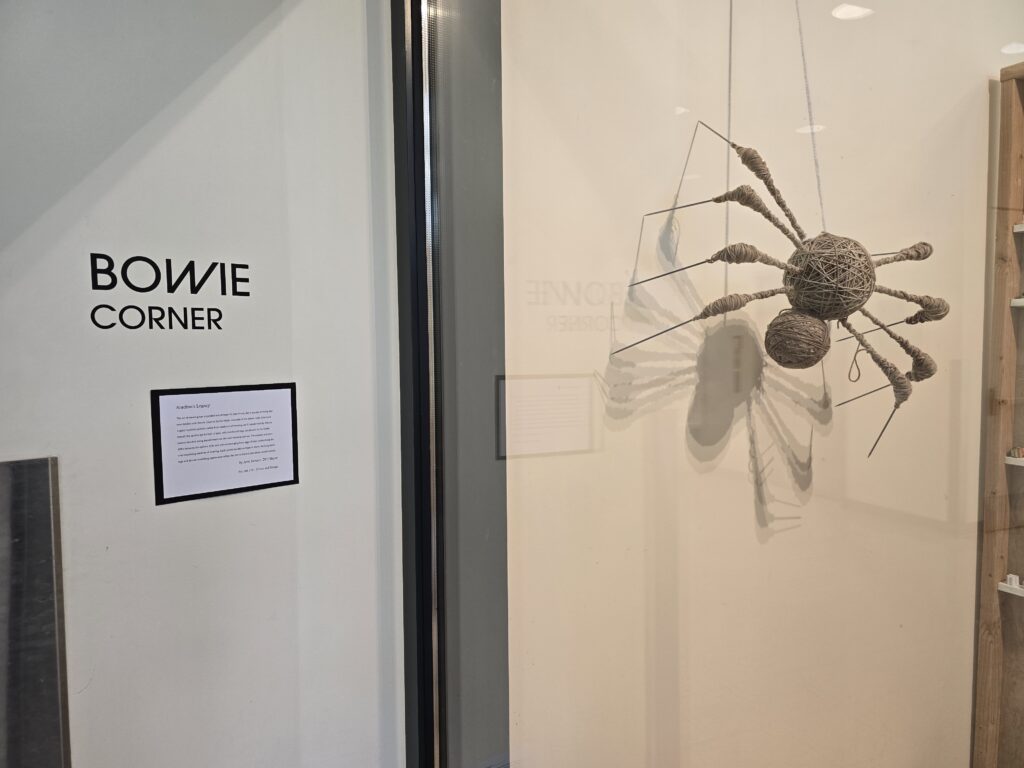
Take a short walk nearly anywhere on campus and you’ll likely run into some form of art. Whether it’s newer additions, like the Cougar Pride statue outside of the Clark College Building (CCW), large paintings hung in the Life Sciences Building (VLSB), or older ones, like the Wailing Bell, found on the walking trail near Orange Lot 1. Some art, on the other hand, is much more noticeable, such as the gallery space in the Dengerink Administration Building (VDEN), a space that hosts occasional exhibitions.
But how much of the artwork displayed around campus is actually made by students? Outside of the Multimedia Classroom Building (VMMC), the answer is “very little.” The only other opportunity for artistic representation is in the VDEN gallery. Even then, most of the shows display artworks from non-local and non-student artists.
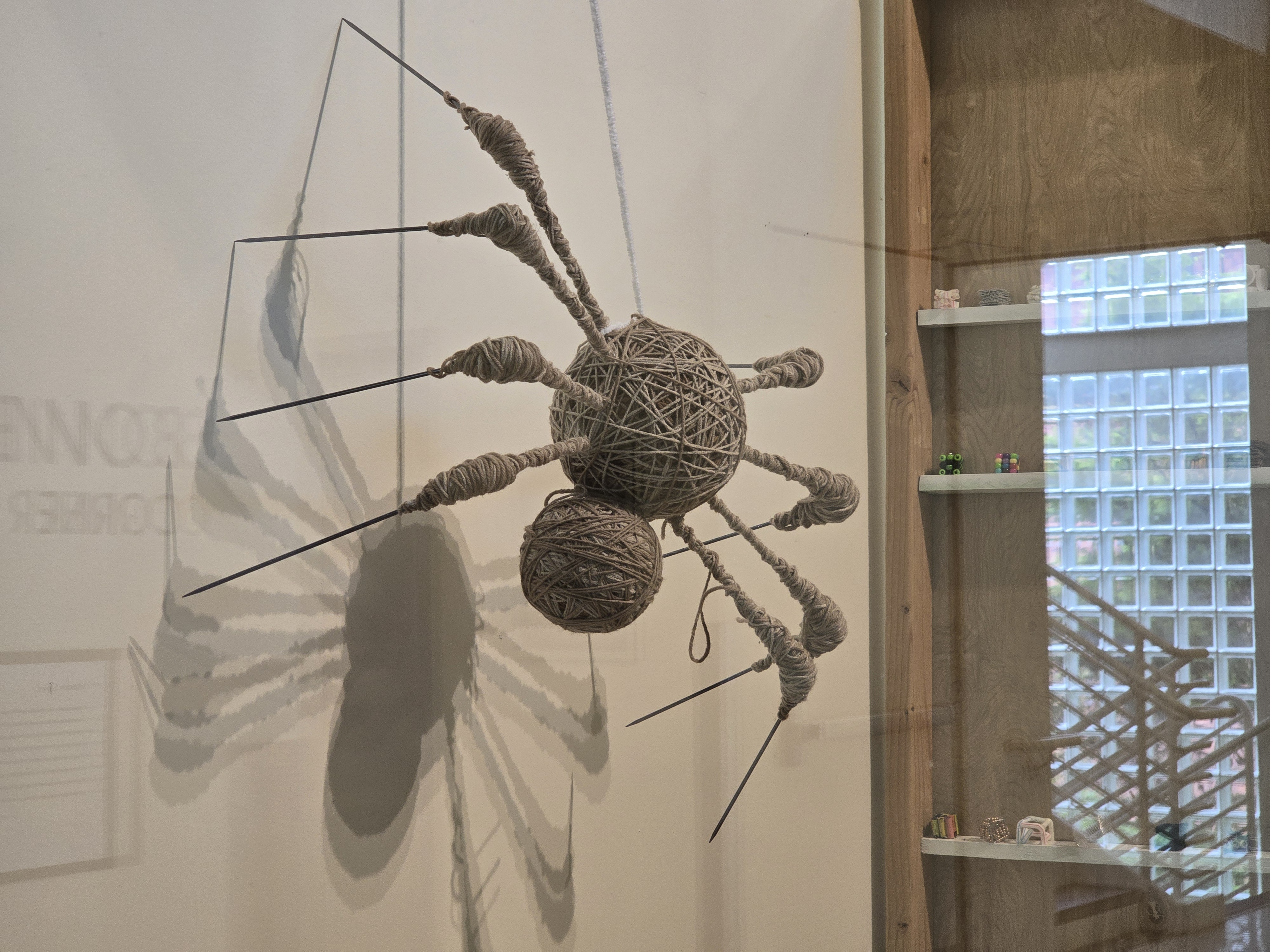
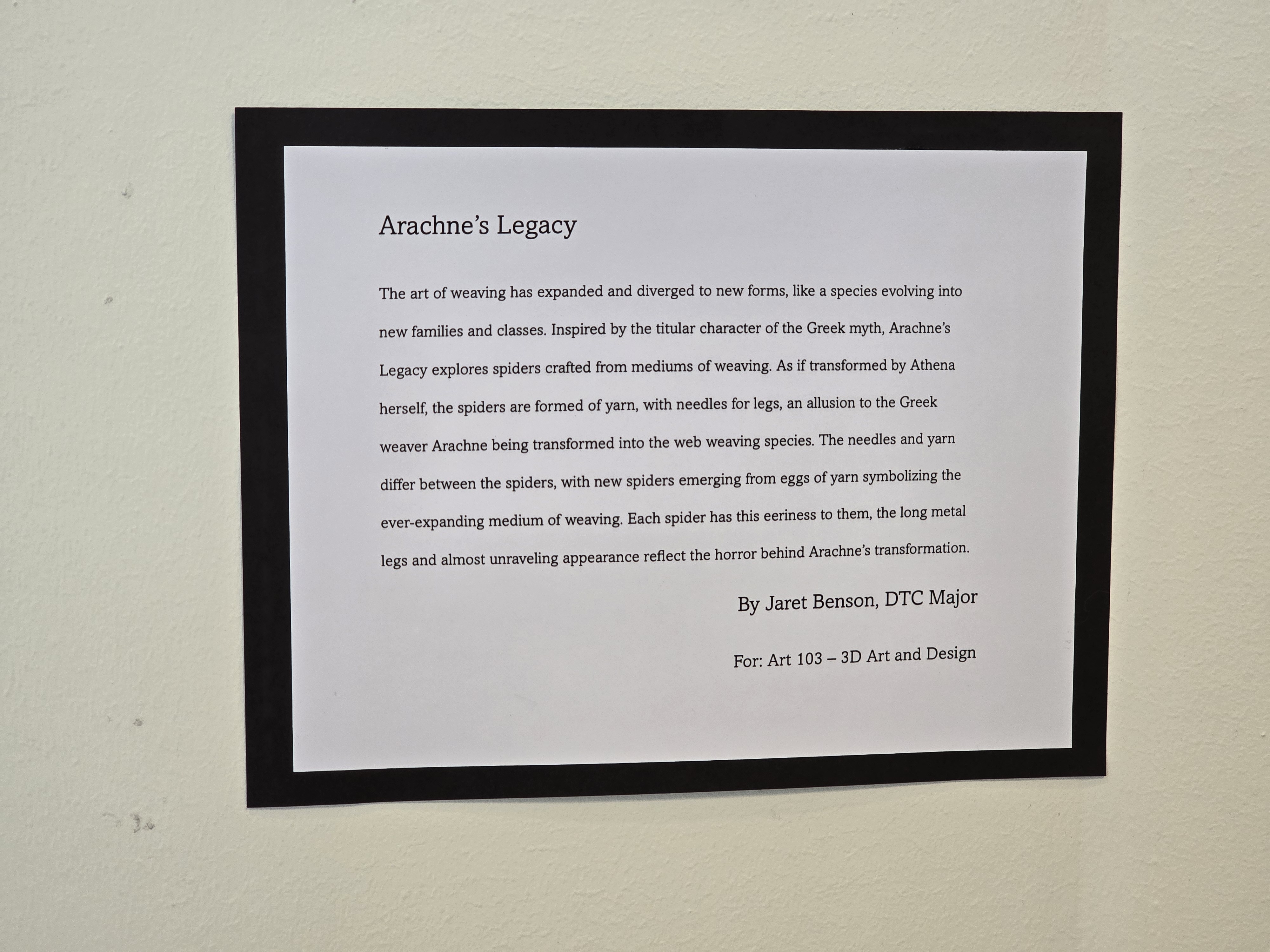
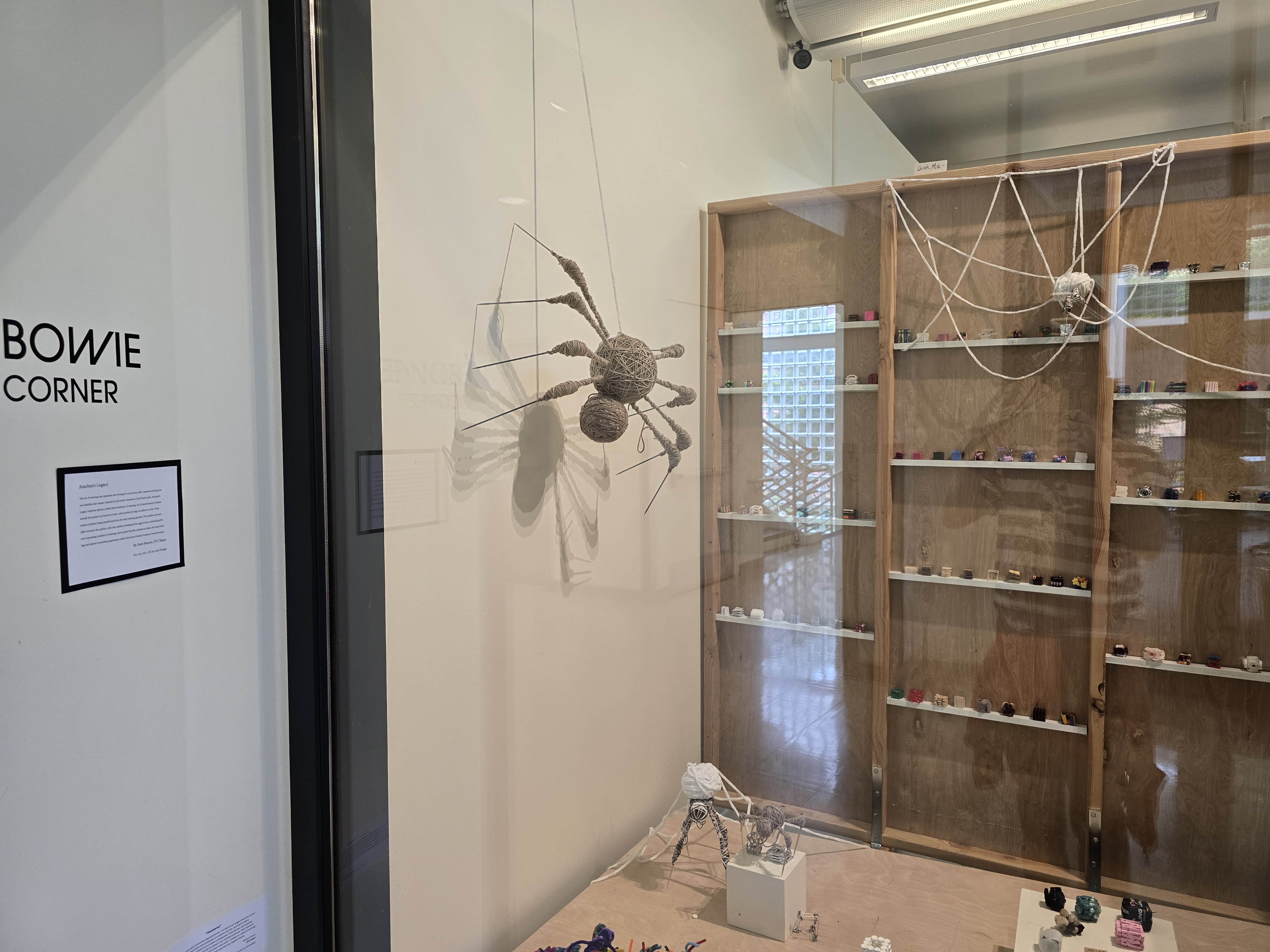
This story highlights one student artist, Jaret Benson, a 2025 graduate whose standout work is currently on display in the Bowie Corner in VMMC. Jaret is a mixed-media artist that gets inspiration from world-building, narratives, and mythology. Their artwork spans a range of media forms, from 3-D animation and still lifes, to woven sculptures. On display in the Bowie Corner, a small gallery behind glass in the lobby of VMMC, is Arachne’s Legacy, a collection of large yarn-woven spiders with sharp legs made of needles. The imagery is striking enough to make many wonder about their meaning or the artist behind the project. In this interview with Jaret, we discussed the inspirations behind the creatures, his creative process, his artistic motivations, and more.
Q: Could you describe the inspiration behind this piece and what it means to you?
A: “Part of the inspiration was finding a fun aesthetic. I thought yarn and needles would be interesting. Yarn is already interesting enough. Having it wrapped and sewn around, it creates an interesting texture. Including the needles gives a creepy aesthetic. I was inspired by the Greek myth of Athena and Arachne, which goes: ‘Arachne was a skilled weaver who tried to bolster to Athena, who was a goddess of craft, and through her artwork she upset Athena, who turned her to a spider, stuck forever weaving her webs.’ I thought it would be cool to utilize that myth. Then I came back to the needles. If a spider was made of yarn, giving it needle legs gives it a creepy aesthetic but also fits with the idea of a weaver transformed into a spider. It’s a creepy creature that is the product of this horrifying experience.”
Q: How would you describe your creative process from start to finish?
A: “When I approach the creative process, I go to the brainstorming [phase], where I think, ‘What’s something interesting or cool?’ I’ll usually start sketching out the gate and see how that evolves, or I’ll try to draw from general thoughts, maybe something that catches my eye that makes me think, ‘Hang on a second!’ For instance, with this project I did a lot of sketches, thinking about materials I could use but also cool [imagery]. When I saw the metal sewing needles, I thought it could be interesting. I’ll then usually do a practice run to see which thoughts work, and if it doesn’t, I think ‘What can I do?” Sometimes, I’ll just come up with a random solution at night and think, ‘Oh, I’ll try that in the morning.’ Once I figure out the look and method [of the project], I gather my supplies and go at it, always thinking about what I could add or what tweaks I can make to punch it up a bit.”
Q: When did you realize that making art was something you wanted to do?
A: “For a long period of time, I thought I wanted to go into paleontology, because I love dinosaurs, [and] I still do. But I’d always doodle in the corner margins and make little sketches for fun in school, never thinking of what I could do with it. But sometime in high school, there was a 3-D animated series I watched called RWBY, which I thought was really cool, and I loved seeing the cool animations and action sequences. That got me thinking about world-building and I thought, ‘Oh my god, what if I just did that?’ So, I started looking into 3-D modeling and animation, which is my big passion. I also wanted to learn other stuff, like concept art. At the end of the day, even art made on a computer is still art, so I really grew a passion [for] that. [I was] thinking about how traditional art could [be implemented] into 3-D work, then I went from there, growing to love the process.”
Q: If you had to say, what is the most fulfilling part of your creative process?
A: “I feel like the process of making [art] is really fun, because it’s so interesting to get that chance to experiment, draft, and conceptualize. I love [making] concept art, where you get the chance to see that process where, it’s like, you have an idea and think, ‘What can I do with it?’ You make all these drafts to visualize it, then think, ‘How could I make that?’ Then you try some stuff, and sometimes it doesn’t work, and a lot of it is just problem solving. You’re like, ‘That [idea] didn’t work; what about this one?’ But sometimes, an idea will come to you, and it’s like a revelation. Like, “Oh my god, I think I’ve figured it out!”
Q: I have an idea about the answer to this question from looking at your website, but is creating art a hobby for you, or do you look at it more as a career path?
A: “I’m pursuing it as a career path, but I consider it both, to be honest. I want a career with my art, getting a chance to bring to life my own project ideas, or to bring about someone else’s, because that can be really fun to craft these stories or ideas. But I do also consider it a hobby, where I love doing something not because it will get me money or a career, but because it’s fun. I consider it both.”
Q: What do you hope to explore next, creatively?
A: “I’m hoping to pursue digital and 3-D projects, like still lifes. I also have a few story-esque ideas, whether it be animations or [sculptures]. I’m always looking at potential ideas, like artwork made by more traditional methods, using things like markers and ink, or 3-D sculptures. I’m always brainstorming and writing my ideas down, conceptualizing them and making sketches, trying to work out if the idea is something I’m interested in pursuing, or maybe if there’s a better idea out there. I’m always searching for the next thing. It’s always interesting to expand your realm of interests.”
You may also like
-
Rising Costs and No Sense of Community on Campus. Students Offer Feedback to WSU President Elizabeth Cantwell at Recent Listening Session
-
New Coug Orientation Goes Through a Revolution, As a Result of WSU’s Systemwide Reforms
-
The Silent Voices: A Chance to Tell Their Side
-
“Terrible” and “Complicated.” Students React to Trump’s State of the Union Address
-
Impressions of a WSUV Douglas Fir