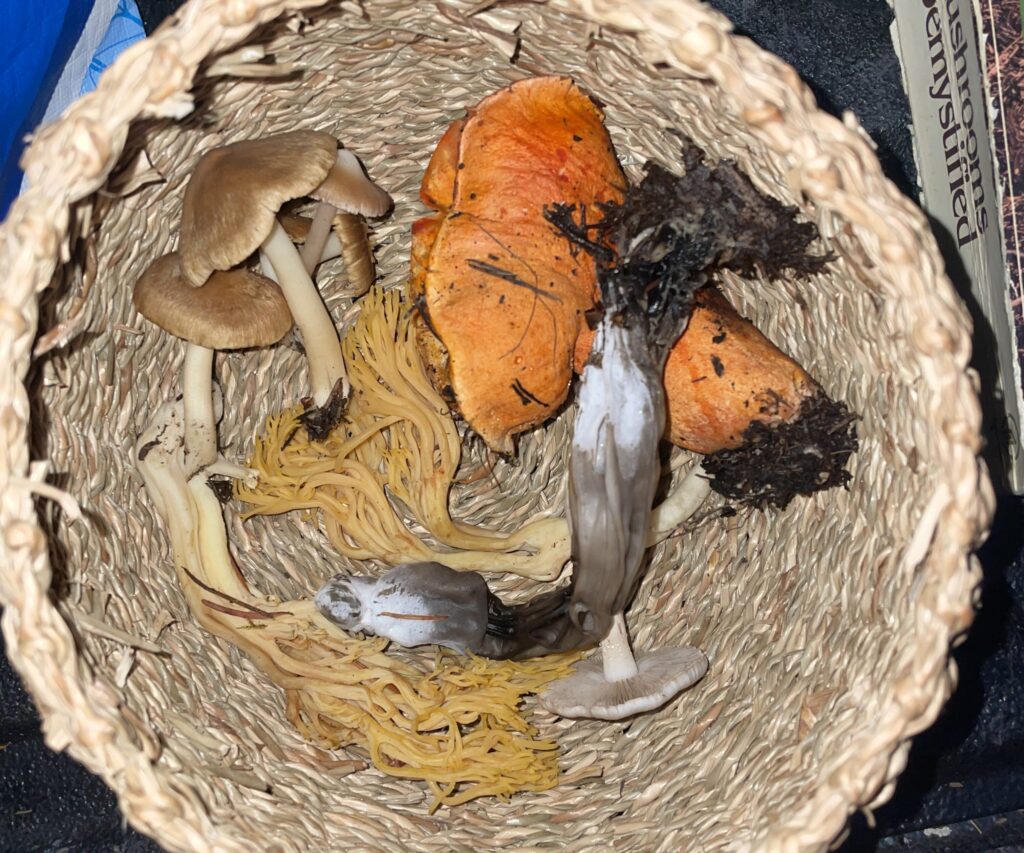
DISCLAIMER: Due to the risk of accidentally ingesting poisonous mushrooms, this article will not act as an identification guide. If you plan on picking your own mushrooms, please consult with field guides, mycological literature, and field experts.
Delicious fruit from the ground is now in season, with many varieties now ripe and ready for picking.
Autumn in the Pacific Northwest brings with it a host of exciting fungal growth, some edible and some poisonous. Increased precipitation mixed with colder weather creates perfect growth conditions for many different mushroom species. Some mushrooms are easily identifiable, while others can be quite tricky to decipher. As the yearly fungal wave is now upon us, this article will highlight a selection of choice gourmet mushrooms in season here in the Pacific Northwest, the ways in which they can be cooked, and a sample recipe for each, highlighting their qualities.
Pacific Golden Chanterelle (Cantharellus formosus)
Among the most popular choice mushrooms that are sought after are the chanterelles. These mushrooms have a signature yellow-orange coloration, a trumpet shape, and false gills. These mushrooms are known to have a somewhat fruity, mild flavor, and can be used in a wide range of dishes, both simple and more complex. These mushrooms work well with herbs, in butter, or as part of a sauce. In this recipe, chanterelles were combined with creamy garlic sauce and seared trout.
Fun fact: The Pacific Golden Chanterelle is the official mushroom of Oregon.
Lion’s Mane (Hericium erinaceus)
There are not many mushrooms that can be mistaken for Lions Mane. Their predominant characteristic is a set of “teeth”, jagged protrusions across its bulbous fruiting body that resembles the mane of a lion. These mushrooms have been described as having a slight seafood taste, like
lobster or crab. They are stringy and meaty when cooked, and work well seared or sauteed on their own, or as a seafood or meat substitute. This recipe highlights the meaty quality of the mushroom in a simple pan-fried Lions Mane recipe. While you may think that most uses of mushrooms are in layered dishes, there’s nothing wrong with enjoying them on their own, as this guide shows.
Fun fact: Lions Mane has promising medical applications, one of which that is currently being studied is its possible neuroregenerative effects.
Lobster Mushroom (Hypomyces lactifluorum)
The lobster mushroom is commonly described as having a bright orange color, with irregular growth patterns, resulting in hard, bulbous fruiting body that has a white interior, and a seafood-odor. Unsurprisingly from its description and name, this mushroom can be used in much the same way as the previous entry, Lions Mane. If you’re a fan of pasta, this lobster mushroom pasta recipe is a good example of how this fungus can be used to create a rich and creamy pasta dish.
Fun fact: The lobster mushroom itself is not actually a real mushroom, but a Rusulla or milk-cap mushroom infected with and transformed by a parasitic fungus.
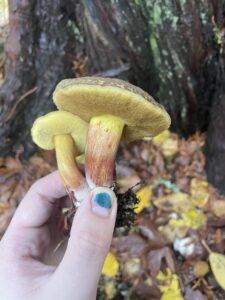
King Bolete (Boletus edulis)
The King Bolete on first glance appears to exhibit the common mushroom features: a uniform vertical stock, and a round cap. The biggest differences being its thick nature, and lack of gills, as Bolete’s have pores instead of gills. This mushroom has a
mild, nutty flavor that is good on its own (fried or sauteed), in pasta dishes, as well as in soups. This Porcini-Cremini soup recipe highlights the King Boletes strength when paired with soup.
Fun fact: Boletes can grow to be very large. One bolete, the Salmon Gum Mushroom, is the largest terrestrial mushroom in Australia, with reports of one bolete weighing 64 pounds!
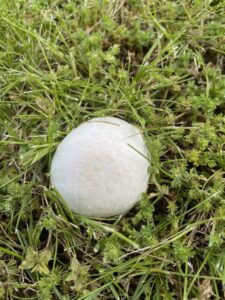
Western Giant Puffball (Calvatia booniana)
Puffballs are another easily identifiable fungus. These white mushrooms tend to grow in fields and pastures and have no stem, making them easy to tell apart from most fungi. When fresh, these spherical mushrooms have solid white interiors. One of the most popular uses of puffballs is as a tofu alternative, but as with many fungi, these mushrooms can also be cut into slices and fried in butter, used as meat substitutes, as well as in pastas and soups. This puffball spin on Sichuan ma po tofu is a good example of the puffball’s versatility as a tofu substitute.
Fun fact: While usually much smaller, the western giant puffball can grow to be over two feet in diameter!
You may also like
-
Rising Costs and No Sense of Community on Campus. Students Offer Feedback to WSU President Elizabeth Cantwell at Recent Listening Session
-
New Coug Orientation Goes Through a Revolution, As a Result of WSU’s Systemwide Reforms
-
The Silent Voices: A Chance to Tell Their Side
-
“Terrible” and “Complicated.” Students React to Trump’s State of the Union Address
-
Impressions of a WSUV Douglas Fir