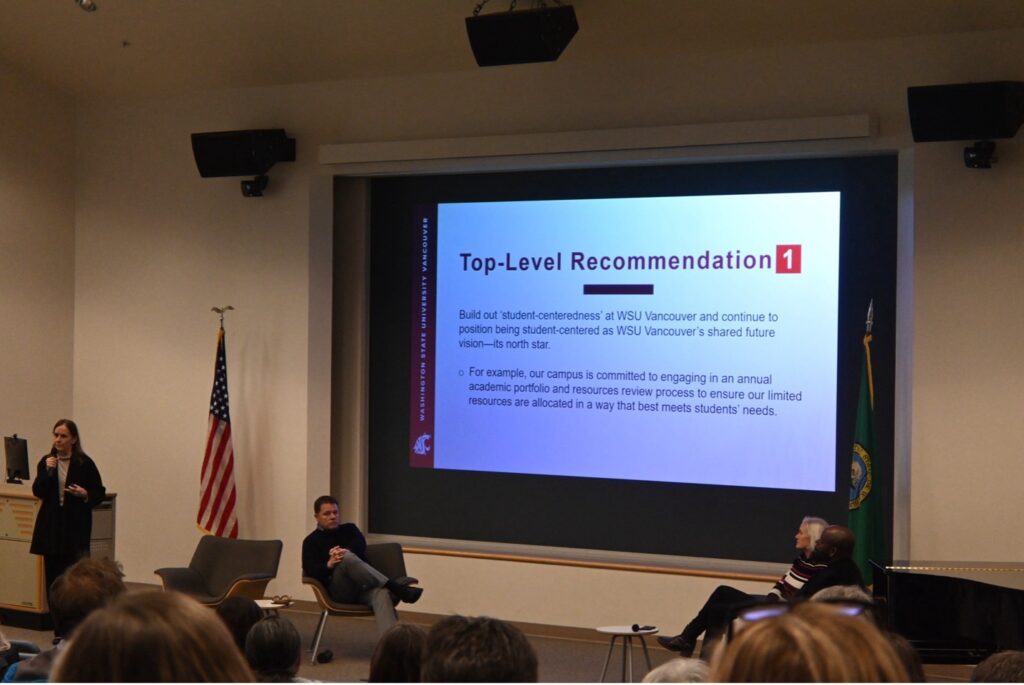
“Everything in there is a recommendation. I think that is really important for us to keep in mind because we may or we may not adopt those recommendations, recommendations based on what RPK heard from our faculty, staff, and students.” According to Interim WSU Vancouver Interim Chancellor Sandra Haynes
The Administrative Services Review Project, one of two reviews that the RPK Group conducted since the beginning of Summer 2025, has been released and is available for all to read.
According to Haynes, “RPK worked with WSU faculty, staff, students, and leaders to help us look at the administrative services and to make sure we are operating those services in a way that truly supported our mission.”
According to Interim Chancellor Sandra Haynes, the RPK Group identified six key recommendations based on faculty, staff, and student input:
- Build out student-centeredness as the campus “North Star.”
- Establish a culture of data governance and informed use.
- Implement measurable performance metrics for administrative units.
- Respond to enrollment challenges with defined roles and retention strategies
- Adjust the chancellor’s cabinet structure to support student success
- Revisit remote and hybrid work practices to ensure accessible services
In regards to building out “student-centeredness,” the report recommends commitment to WSUV’s current undergraduate research opportunities, working to clarify how students are informed and can access student-focused services, and exploring more on-site food options, among other things.
Furthermore, the Office of Community and Collaboration, formerly the Office of Diversity, Equity and Inclusion, is recommended to work on clarifying its purpose and impact, while ensuring its mission supports the “broader mission of WSUV.”
Establishing a “culture of data governance” largely boils down to using data for a variety of purposes, including evaluating the impact and return-of-investment on the library’s laptop lending program.
Implementing “measurable performance metrics” largely focused on improving internal workflows, as well as making the student experience with advisors more “seamless.”
Responding to “enrollment challenges” included a collection of strategies to address enrollment, including ensuring that “academic offerings are aligned with student demand.”
Adjusting the “chancellor’s cabinet structure” included more internal collaboration at WSUV.
Finally, revisiting “remote and hybrid work practices” is focused on ensuring that “services are in-person and consistently accessible.”
The event took place in the Town Hall at WSU Vancouver and was hosted by Interim Chancellor Sandra Haynes, who oversees all campus operations at WSUV and serves as Chief Executive for WSU Tri-Cities. Haynes was joined by Vice Chancellor Christine Portfors for Research and Graduate Education, as well as the Interim Vice Chancellor for Academic Affairs at WSUV. Interim Vice Chancellor Damien Sinnott of Operations and Finance for WSUV, who additionally serves as Vice Chancellor for Finance and Administration at WSU Tri-Cities. The final correspondent present was Vice Chancellor Dominic Vanthom for Student Affairs and Enrollment at WSUV.
“We will be looking at those recommendations and will be deciding as a group what we think will work for us and what we may say nope no thank you, we don’t think that necessarily going to work for us, but they gave us a lot of information to work with, so we will be contacting you and will be working together to make sure we implement the right decisions and the decisions we think is best for WSUV” According to Interim WSU Vancouver Interim Chancellor Sandra Haynes
Review Process
During the Fall Semester, the RPK Group came and interviewed 28 leaders across campus and solicited feedback from faculty, students, and staff. They also reviewed organizational charts and made follow-up requests for additional information when needed.
In addition to the interviews, surveys were distributed to faculty and staff to gather feedback on administrative functions, 101 responses, thus being 50 faculty members, 46 staff members, and 5 anonymous responses. The separate student survey offered to student provide feedback on the four core services, which were orientation, advising, course scheduling, student clubs, and organizations, resulting in 77 responses.
At this time, we can confirm that on February 3rd, from 3-4:30 pm, the second report for the Academic Portfolio and Resources Review will be in the Town Hall (Dengerink Administration Building Room 110).
You may also like
-
Rising Costs and No Sense of Community on Campus. Students Offer Feedback to WSU President Elizabeth Cantwell at Recent Listening Session
-
New Coug Orientation Goes Through a Revolution, As a Result of WSU’s Systemwide Reforms
-
The Silent Voices: A Chance to Tell Their Side
-
“Terrible” and “Complicated.” Students React to Trump’s State of the Union Address
-
Impressions of a WSUV Douglas Fir