In the Life Sciences Building, one may not expect to find art, let alone art made using bacteria grown on agar petri dishes.
In Room 211 of the Life Sciences Building is a series of Petri Dish art pieces, which are a part of the SciArt project, which is hosted by professor Gunjan Gakhar and technical assistant Ryan Watson. This project aims to increase interdisciplinary activities between students of science and other majors, offering chances to collaborate that otherwise might not happen.
“The primary thing behind the SciArt project was that Gunjan has been very big about interdisciplinary activities, so getting our science students more involved with other majors around campus.” Watson said.
For each of these pieces, two students came together, using their different skill sets to create a product of both art and biology. This brings together both the scientific process of growing bacteria as well as the artistic process of shaping the material into art. In turn, both art and science are mimicking each other.
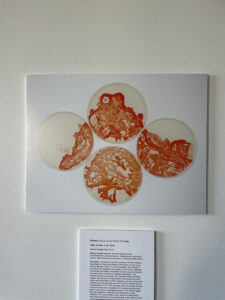
In Hidden in the Reef, a piece created by Sunny Ly and Oscar Gonzalez, an octopus is depicted in bright oranges, reds and creams. The octopus was chosen because it highlights themes of biomimicry through the octopus’ ability to camouflage, and how
this could be used as inspiration to solve challenges.
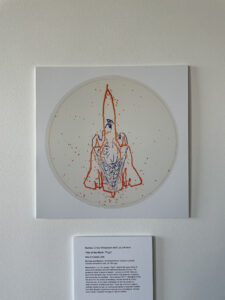
In Flight, made by Chloe Williamson and Lux Johnson, viewers can see an overlapping depiction of a Peregrine Falcon against a Lockheed-SR-71 “Blackbird.” This draws parallels between nature and humanity, and how they inform and inspire one another. The Peregrine Falcon, the fastest bird on earth, juxtaposes the orange outline of the SR-71, the fastest manned aircraft. The lack of contrast (aside from color) between the two exemplifies the interconnection between nature and how we respond to it.
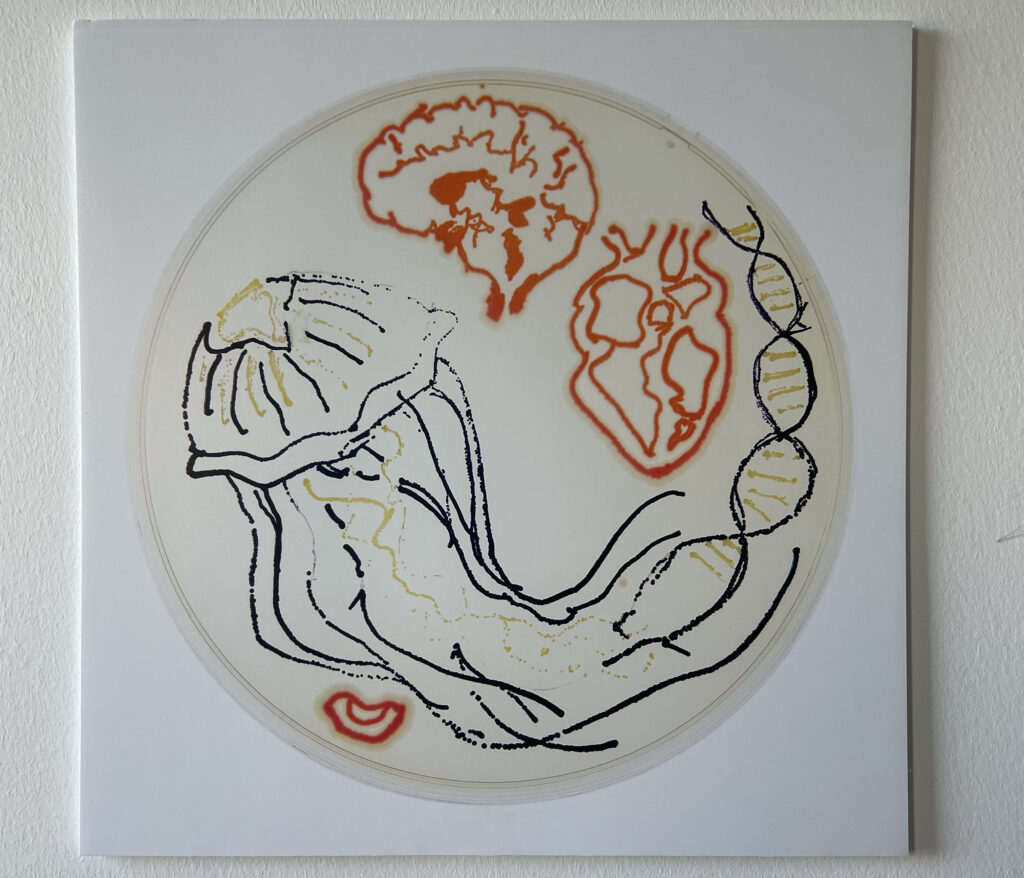
Glowing Insights: Jellyfish-Inspired Medical Imaging was made by Gisselle Ruiz and Samantha Garcia. In this agar plate, a jellyfish swirls around the plate, its tentacles transforming into strands of DNA. In the background, a blood cell, heart, and
brain are depicted. These are representative of the scientific applications of Green Fluorescent Protein; a protein found in jellyfish, used in science classes, to visualize proteins and gene expression.
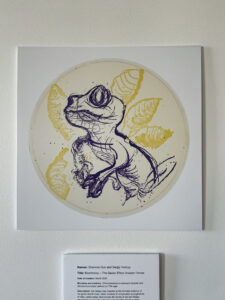
In The Gecko Effect Unseen Forces, made by Shannon Guo and Sergiy Voznyy, the connection is explored between the gecko’s incredibly dexterous toes, and how this phenomenon has inspired the invention of strong glueless adhesives, used in industries like the medical field, robotics, and manufacturing.
The SciArt project explores themes of how humanity interacts with nature, reflecting elements of the natural world in a new way. By exploring how mankind reflects natural motifs and integrates them into an “artificial” world, we can, in a sense, create a new mimicry through the act of creating art. The act of using bacteria grown on agar plates to make art also challenges the common notions of what constitutes an artistic medium.
You may also like
-
Rising Costs and No Sense of Community on Campus. Students Offer Feedback to WSU President Elizabeth Cantwell at Recent Listening Session
-
New Coug Orientation Goes Through a Revolution, As a Result of WSU’s Systemwide Reforms
-
The Silent Voices: A Chance to Tell Their Side
-
“Terrible” and “Complicated.” Students React to Trump’s State of the Union Address
-
Impressions of a WSUV Douglas Fir