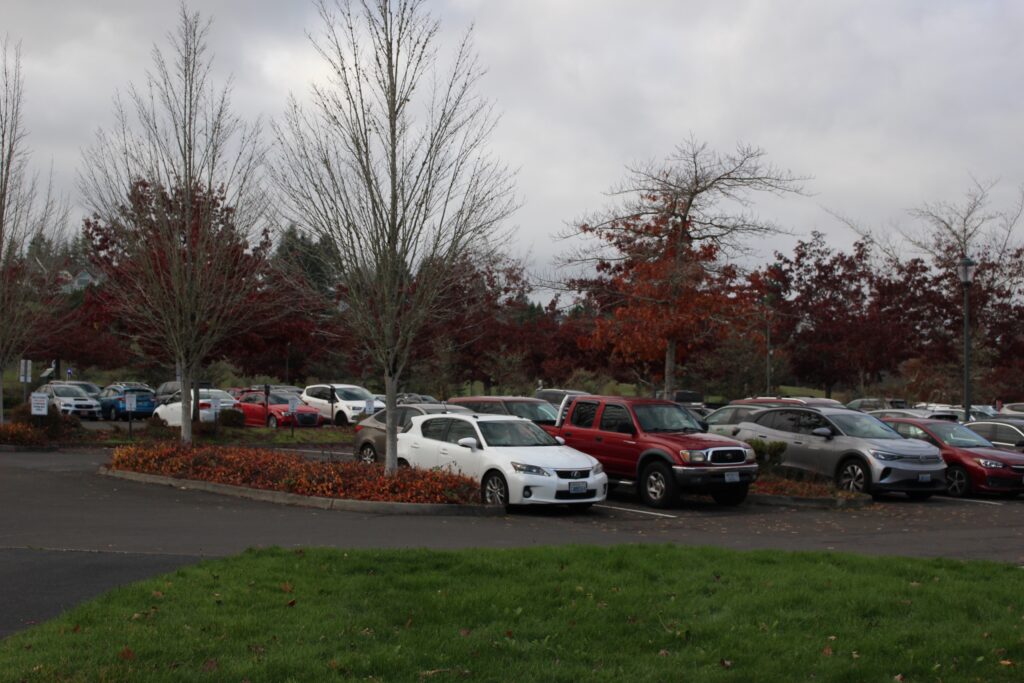
Parking costs at Washington State University Vancouver are likely to increase in the near future as infrastructure and maintenance expenses continue to rise, according to ASWSUV President Jacob Windstead and Vice Chancellor of Finance and Operations Damien Sinnott.
When addressing the importance of improving transparency and communication around parking, particularly to new students, Windstead said student concerns about parking costs often stem from clarity about how fees are set and whether they could increase over time.
As ASWSUV president, Windstead added that learning how parking services operate helped him better understand why costs rise, but emphasized that students want transparency and predictability.
“Students really want to know where their money is going,” Windstead said. “If something were to be agreed on, it should be in writing, whether it’s subject to increase or reviewed every few years.”
According to Sinnott, parking services at WSU Vancouver operate as an auxiliary service, meaning the department must be financially self-sustaining and not supported by tuition dollars or state funding. Parking Services at WSU Vancouver is supported by revenue generated from parking fees.
“[Parking fee increases] have been pretty modest relative to the CPI [Consumer Price Index], and I don’t control these costs, and so we have to have a revenue stream that is large enough to cover those expenses to maintain what we have,” Sinnott said.
One potential alternative discussed by both Windstead and Sinnott was a mandatory parking and transportation fee, similar to the model used at WSU Tri-Cites.
Sinnott said that such a model would cover parking, safety and other transportation-related expenses. It could also spread costs more evenly among students, and Sinnott said it could be included in financial aid calculations.

Windstead said this would “change a little bit of culture here in a sense,” describing how colored parking lots would change and be a free-for-all due to the same lump fee, and everyone would be allowed to obtain whatever parking spot is available.
Windstead added that all students–even those who don’t drive to campus or are dropped off–would have to pay the fee. While this was addressed at WSU Tri-Cities by providing a bus pass, WSU Vancouver students are already provided with one under the current model.
Furthermore, Sinnott added, “It’s a detail that we’d have to work out. I don’t have an answer. I didn’t have to do that on the Tri-Cities campus because we don’t really have as much infrastructure, and we don’t have colored lots.”
Windstead said that his team gathered parking and permit data and ran initial calculations but emphasized that the numbers were difficult to pin down, unverified, remained theoretical, and that logistical details would still need to be worked out.
All things considered, alternative parking models have been discussed in theory, but Sinnott and Windstead emphasized that logistical details, equity concerns, and cost estimates would need further review before any changes could be considered.
Sinnott addressed that “I’d be more than willing to analyze and look and have longer, deeper conversations about it. I don’t know how much control I will have to be able to get those to a place where students are happy; that balance is important to me.”
However, Sinnott emphasized that any change to the parking funding structure would require student approval. “Students would have to vote in favor of a fee for that to happen,” Sinnott said.
While no immediate changes to parking fees have been announced, any future adjustments or alternative funding models would require student involvement and approval.
You may also like
-
Rising Costs and No Sense of Community on Campus. Students Offer Feedback to WSU President Elizabeth Cantwell at Recent Listening Session
-
New Coug Orientation Goes Through a Revolution, As a Result of WSU’s Systemwide Reforms
-
The Silent Voices: A Chance to Tell Their Side
-
“Terrible” and “Complicated.” Students React to Trump’s State of the Union Address
-
Impressions of a WSUV Douglas Fir