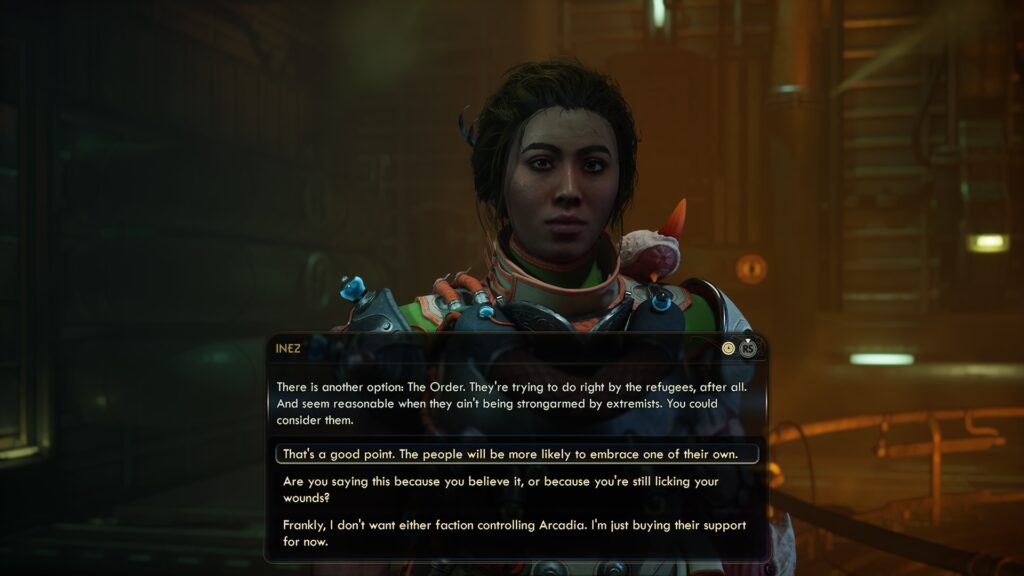
The best kind of role-playing games are the kinds that present you with too many options — so many that you’ll be inclined to replay through it again and again just to see how differently things could end up. This is the goal that The Outer Worlds 2 sets for itself and it exceeds beyond what most RPGs dare to offer.
This is a sequel to The Outer Worlds (2019), a highly replayable albeit short game. The first of the series can be completed in 20-30 hours, and proved divisive around Obsidian Studios fans who celebrated them for prior games such as Star Wars: Knights of the Old Republic 2 and Fallout: New Vegas.
The faults with the first game were largely basic combat and buildcrafting (the equipping of gear that lends the player various stats in combat for a variety of playstyles) as well as the aforementioned short playtime, yet its storytelling and the bevy of player choice that could be found in quests and dialogue enamored those who accepted the game for what it was. This included its delightfully satirical story set in an ultra-capitalist dystopia. At the time it was also one of the few games to include a prominent asexual character, the beloved fan-favorite companion Parvati.
The sequel takes that incredible world and player choice, while addressing every fault with the previous entry. The combat is expanded to provide players with a greater variety of weapons, with some truly creative ones such as a gun that shoots advertising bots to taunt enemies, or a rocket-pistol.
Meanwhile, the perks and skill trees have been revamped to more forcefully pigeonhole players to specialize into specific playstyles, rather than being a jack-of-all-trades. This creates variety as players could have an entirely different experience playing through a second or third time, whether they want to lockpick or hack their way to victory, talk their way out of combat, or just shoot anything that moves.
One thing truly special about the game is the “flaws” system. The game tracks everything that players do, and will occasionally offer players to take such a “flaw,” which usually includes a downside as well as an upside. One example is “bad knees,” where players’ knees crack loudly every time they crouch, alerting enemies within 10 meters to their position, yet players also gain faster crouch movement speed to sneak around faster.
“Flaws” are irreversible once accepted, while players can’t respec (reset their chosen skills or traits) beyond the beginning of the game. This leaves the player with big choices, and incentive to play again and try different builds. One of the most bold things included here is a “flaw” called “flawed,” which forces players to accept every “flaw” the game offers, for those who want a truly wacky experience.
The story, and playtime as a whole, is considerably longer, clocking in for most players around 50-70 hours. Taking place well after the first entry, the Spacers’ Choice faction has merged with the Auntie Cleo faction to become Auntie’s Choice, providing commentary on rampant capitalism and corporate greed. Meanwhile the Order of the Ascendents base their religion on using math to understand the future, with dialogue seemingly providing satire on advancements in AI.
While none of the companions in The Outer Worlds 2 compare with the likes of Parvati or Vicar Max from the first game, the six offered here are still fascinating characters. A few are incredibly loyal to either the Auntie’s Choice or Order of the Ascendents factions, offering depth and differences of opinion among the characters in the player’s crew.
Like the first game, there is plenty of comedic satire on rampant capitalism in The Outer Worlds 2. Some fans complained that the first entry had so much humor it sometimes broke the immersion and felt like it was trying too hard to be funny. The sequel is much sharper, still keeping enough of the humor to stay true to itself, while telling a much more self-serious war story to up the stakes and tension.
Sequels are supposed to be better in every way, and The Outer Worlds 2 squashes every bit of criticism the first game had. Its story is longer, the worlds are larger, there is even greater variety in ways to play, and the replayability is amped up to 11 in its loot and perks. There is a more fleshed out world, with sharper humor that is better balanced with a more gripping and serious story, replete with themes relevant to the state of capitalism today.
Fans of Obsidian Studios — rejoice, this is the kind of RPG you’ve been waiting for.
You may also like
-
Rising Costs and No Sense of Community on Campus. Students Offer Feedback to WSU President Elizabeth Cantwell at Recent Listening Session
-
New Coug Orientation Goes Through a Revolution, As a Result of WSU’s Systemwide Reforms
-
The Silent Voices: A Chance to Tell Their Side
-
“Terrible” and “Complicated.” Students React to Trump’s State of the Union Address
-
Impressions of a WSUV Douglas Fir