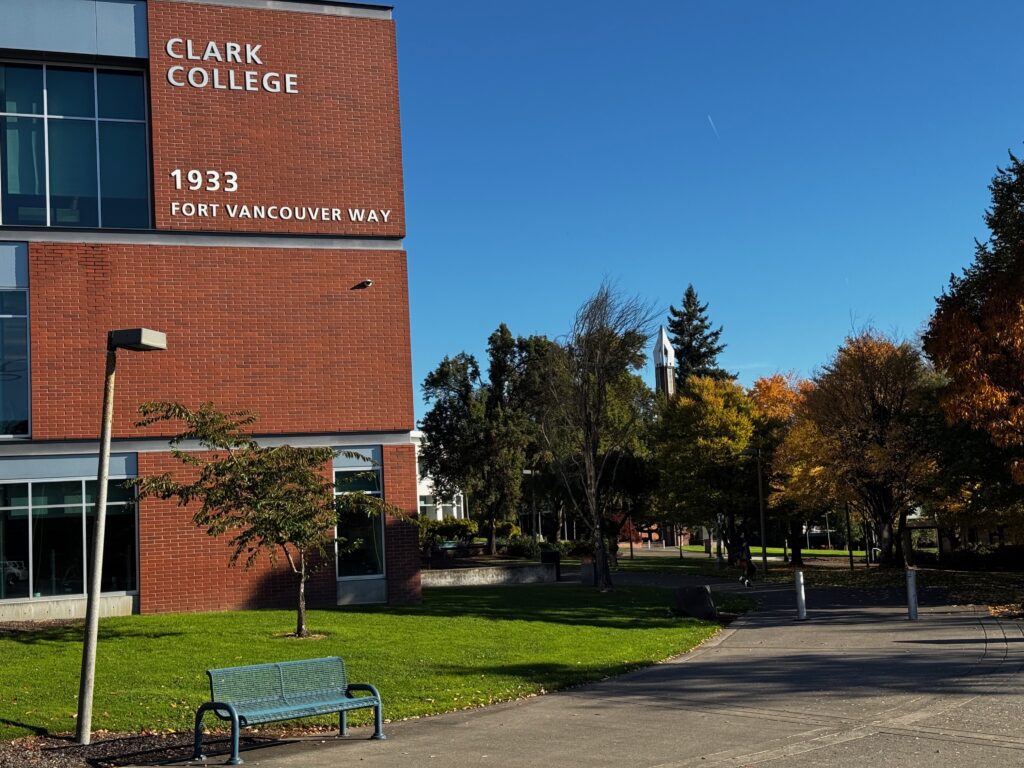
Clark College at WSU Vancouver would summon security officers to intervene in an enforcement occurring on the college’s publicly accessible premises. Those officers would be seeking a judicial warrant or subpoena that Clark officials would seek to verify.
Meanwhile WSU Vancouver, whose campus hosts Clark, would avoid intervention on its broader campus grounds and simply call the state’s attorney general’s office for guidance (see adjoining story). The institutions are otherwise aligned in their immigration-related practices, and both adhere to state law.
A Clark College spokesperson, who wished not to be identified, made clear that Clark staff is directed to contact campus security immediately and refer anyone attempting to engage in immigration enforcement on Clark’s campus to Clark’s Security Office (Gaiser Hall, Room 118). Then Clark’s Director of Safety and Security, as well as its Vice President of Operations and legal counsel, would evaluate the documents, the spokesperson said.
Only after confirming the legitimacy of a warrant might ICE officers gain student information, and only the college president or their designee could authorize such access.
Clark College adopted its own Immigration Rights and Non-Discrimination Policy in late January. Clark says on its website that the college’s resources are not to be used to “engage in, aid, or in any way assist with immigration enforcement.”
WSU Vancouver, meanwhile, operates under policies held by the greater WSU system and the Keep Washington Working Act. WSU policy states that ICE officers may access the public parts of campus but are barred from nonpublic areas such as classrooms in the absence of a judicial warrant or subpoena. In the case of WSU Vancouver, the legitimacy of the warrant would be established elsewhere, by the attorney general’s office and possibly take a day or more, according to a Vancouver vice chancellor. Student information cannot be shared without a valid warrant.
Both Clark and WSU Vancouver advise employees not to engage with ICE officers through either assistance or obstruction.
Instead, WSU Vancouver employees are to refer officers to the Chancellor’s Office, who will then direct the Vice Chancellor of Student Affairs to consult with the Office of the Attorney General, in order to verify the legitimacy of a warrant or subpoena issued by officers.
(Article revised and updated on October 22, 11 p.m.)
_____________________________________________________________
CORRECTION
An earlier online version of a story depicting Clark College’s practices in the event of an ICE enforcement misstated access to Clark’s building at WSU-Vancouver. Clark is fully accessible to any member of the public, including federal authorities, as it is a public institution. Separately, Clark has not updated its policy since adoption of them in January. The VanCougar regrets the errors. -The editors
You may also like
-
Rising Costs and No Sense of Community on Campus. Students Offer Feedback to WSU President Elizabeth Cantwell at Recent Listening Session
-
New Coug Orientation Goes Through a Revolution, As a Result of WSU’s Systemwide Reforms
-
The Silent Voices: A Chance to Tell Their Side
-
“Terrible” and “Complicated.” Students React to Trump’s State of the Union Address
-
Impressions of a WSUV Douglas Fir